Telling a companion app from a con artist sounds like a silly thing to worry about, and for most people it is. Even so, the two look alike on the surface: warm messages, attention whenever you want it, and a nudge to pay. Scammers know that people who already chat to AI are comfortable with all three.
How much damage romance scams do
In Australia, the National Anti-Scam Centre's Targeting Scams report pooled data from Scamwatch, ReportCyber, IDCARE, the Australian Financial Crimes Exchange and ASIC. It put reported romance scam losses at A$156.8 million for 2024, the second-largest category after investment scams, and A$139.9 million for 2025.
For comparison, in the US the Federal Trade Commission logged US$1.14 billion lost to romance scams in 2023. Those are US numbers, shown here only for scale.
All of these figures count only the people who spoke up. Agencies keep saying romance fraud is badly under-reported, mostly because victims feel embarrassed.
The FTC also found that nearly 60% of US victims who lost money to a romance scam in 2025 said it began on social media. Scammers tailored the pitch to the person's profile, then asked for money as either a sudden emergency or a "tip" about an investment platform.
What AI took away from the old warning signs
Romance scammers used to give themselves away: clumsy English, stock photos that turned up in a reverse image search, endless reasons not to be on camera. AI has removed most of those clues.
- Polished writing in any language. Nobody needs to write well, or speak yours, to sound fluent now.
- Faces that exist nowhere else. A generated photo has no earlier copy for a reverse image search to find.
- Live fake video and voice. Face swapping and voice cloning run in real time on ordinary hardware.
- Volume. With a chatbot doing the typing, one person can juggle dozens of believable chats.
That is why the classic tip, "ask for a video call", no longer settles anything.
Four checks that separate a product from a con
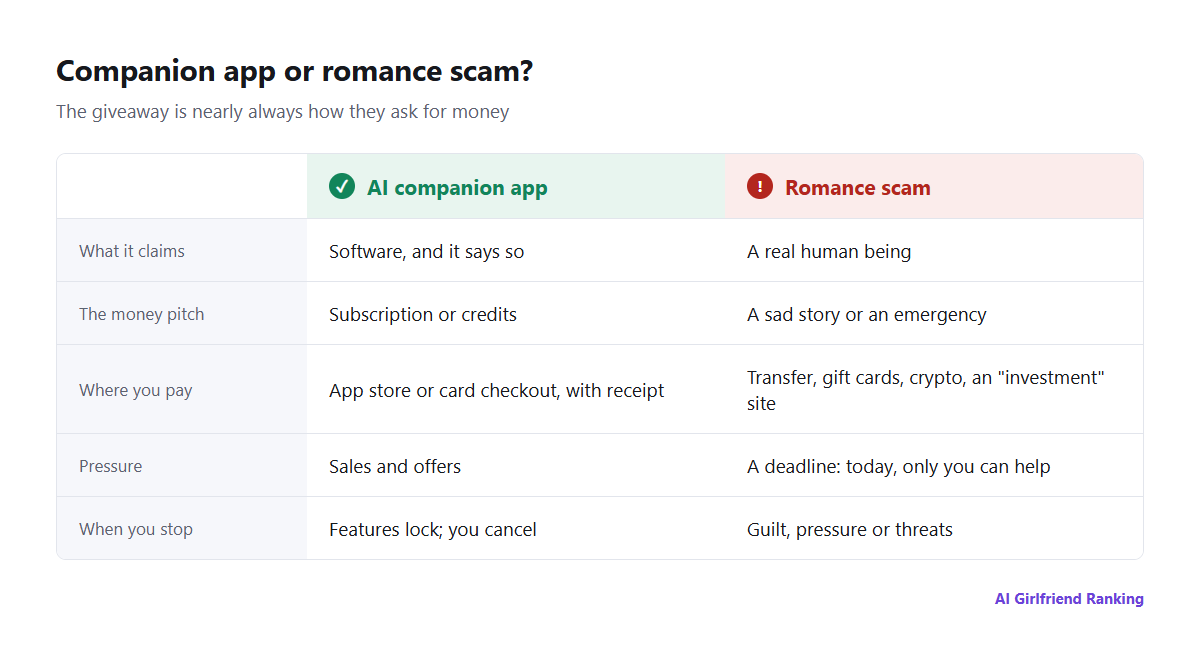
Where a companion product stops and a con starts.
1. It insists it's a human. A companion app is upfront that you're talking to software. For how the rules on this are developing, see our look at AI companion laws. Somebody you met online who is always available, always agreeable and never able to meet in person is the opposite of that.
2. The money leaves through a side door. Real apps bill via an app store or a card payment page, and you get a receipt and a way to cancel. Scammers ask for bank transfers, gift cards, cryptocurrency or a deposit on an "investment platform" you've never heard of.
3. There's an emergency with a deadline. A hospital bill, a customs fee, a frozen account, a flight home. It's always urgent, only you can fix it, and it has to happen today. Products don't behave like that. People running a con do.
4. It wants to move the chat. You get steered fast to WhatsApp, Telegram or another private app, away from the platform's moderation and your own chat history.
One of these is reason enough to stop. Two together are as good as certain.
Scams that go after companion app users
Some fraudsters pick on people who already use companion apps, because they know these users pay for digital intimacy.
- Copycat apps. Knock-offs of well-known apps with slightly altered names, in the stores or behind ads. Install only from the official store listing or the company's own site.
- "Premium unlock" deals. Cheap lifetime access, cracked versions or credit packs pushed through Telegram channels or social media. Best case you lose the money, worst case you hand over your login.
- Account takeover. Phishing emails dressed up as billing problems. A hijacked account exposes your whole chat history, and the defences are in account security for AI companion apps.
- Sextortion. Intimate pictures, real or generated, used to demand payment. Anything you put into an app or chat can leak, as explained in where your pictures actually live.
- "AI girlfriend" profiles on social media. Accounts posing as an AI or a model that steer you to a payment link in a direct message. A real product has a website and a checkout, not a DM.
If money has already gone
- Don't send another cent. That includes the "final payment to release everything", which appears in every version of the script.
- Ring your bank or card provider straight away. Transfers and card payments can sometimes be stopped or disputed if you're quick.
- Hold on to everything: messages, usernames, wallet addresses, receipts. Don't delete the chat, however much you want to.
- Report it. Use the Scamwatch report form, and ReportCyber at cyber.gov.au if it involved cybercrime such as extortion or stolen details.
- Get support. IDCARE is a free national service that helps people recover from scams and identity misuse (1800 595 160).
- Ignore anyone offering to recover your money for a fee. They're the second half of the same scam, and they target people who have just reported a loss.
Scamwatch, the national place to report a scam.
The rule of thumb
A companion app can be overpriced, keen on upselling or plain disappointing and still be exactly what it says it is. A romance scam is a lie from the very first message. The tell is nearly always money: a real companion only asks for it at its own checkout. If something asks another way, it isn't a companion, whatever it calls itself.