Ring a companion and you're testing the hardest thing she does. Wait three seconds for a text and you won't think twice. Wait three seconds for a spoken answer and it feels like she's dropped out.
The gap people expect
Researchers who recorded everyday chat in ten different languages found the typical silence between one person finishing and the other beginning was around 200 milliseconds, with little difference between cultures. Listeners start lining up their answer while the other person is still talking. Stretch the pause well past that and it comes across as doubt, puzzlement or lack of interest.
So an app has to fit a whole production line into roughly a fifth of a second.
Four jobs, done in a row
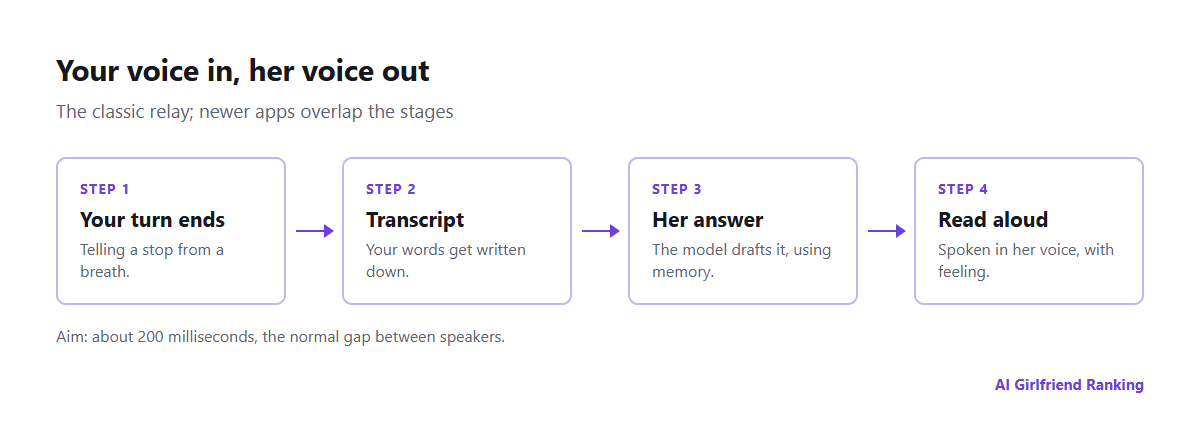
The classic production line. Modern systems overlap or fuse some of these jobs.
- Deciding you've stopped. Is that a full stop or just a breath? Get it wrong one way and she barges in; the other way and there's a dead silence.
- Writing down your words. Your voice is turned into a transcript.
- Composing what to say. The language model drafts an answer in her character, pulling in what it remembers about you.
- Reading it out. The draft is turned into audio, ideally in her signature voice and with some emotion.
In the older approach each job sits idle until the previous one is finished. The newer approach begins speaking the first sentence while later ones are still being drafted, or uses a model that listens and speaks directly, dropping the transcript and the read-out altogether.
Where the bill comes from
| Typing | Voice note | Live call | |
|---|---|---|---|
| Time pressure | Relaxed | Relaxed | Tight |
| Extra software involved | None | Voice generation | Listening, voice generation, knowing when to jump in |
| Length | A few lines | One answer | Anything from minutes to hours |
| What it costs the operator | Least | Moderate | Most |
| How you pay | Part of the plan | Plan or credits | Minute packs, tiers or credits |
During a call all four jobs run flat out for the whole time, often on dearer "live" editions of each model. That's why voice tends to be the first thing rationed, and why an "unlimited" label rarely stretches to it. There's more on this trick in how to read AI girlfriend feature lists.
The marks of a good call
- Consistent speed. A single long silence ruins the spell more than a somewhat slower but steady pace.
- Interruptions that work. Talk over her and she should stop and respond. Without that, you're just sending recordings back and forth.
- The same voice each time. Matching tone, accent and warmth. Our testers heard quality vary from one character to another, even inside good apps.
- Feeling in the delivery. Laughs, pauses, a softer tone. A script read aloud doesn't count.
- Recall over the phone. A few apps use a stripped-down model for calls, so she can know less on the line than in the chat window.
A quick trial before you subscribe
- Ask what the plan includes: notes, calls or both, and the monthly minutes.
- Ring her for two minutes on a free trial or the cheapest tier, using mobile data and again on Wi-Fi.
- Cut in halfway through a sentence. See whether she stops.
- Mention a detail from your typed chats. See whether it registers.
- Check what extra minutes or credits cost. A single lengthy chat can use up a whole month.
For how pictures and voice are priced more generally, read how AI girlfriend images and voice work, and for the question of paying extra just for voice, see premium tiers.
Keep an eye on yourself
Hearing a voice is more absorbing than reading. The 2025 OpenAI and MIT research tied brief voice use to improved wellbeing, but not heavy use every day. Treat it like a treat, and learn the red flags in when an AI companion starts taking more than it gives.