Most people don't notice it happening. Then one morning the app is the first thing you tap, or pulling out of plans has become a bit too painless. Below is how to separate a habit that's still a pleasure from one that's begun to cost you, and what to change if it's the latter.
What the evidence says
The largest piece of work so far was published in 2025 by OpenAI together with the MIT Media Lab. Researchers scanned around 40 million ChatGPT chats automatically, surveyed 4,000 users, and ran a four-week randomised trial with close to 1,000 volunteers. The findings are more cautious than the coverage:
- Heavy daily users tended to report more loneliness, more dependence, more problematic use and less time with other people. It's a correlation only. Nothing in the study shows the chatbot caused it, since lonelier people may just reach for it more often.
- Emotional use was a niche. The bulk of chats were emotionally neutral. A minority of heavy users, especially those on voice mode, treated it emotionally most of the time and were far likelier to describe it as a friend.
- Light voice use seemed to help. Brief sessions went with better wellbeing, though the advantage wore off at high daily volumes.
- Who you are matters. People prone to strong attachment reported more loneliness, and those who trusted the bot more reported more dependence.
There are two takeaways for companion apps. First, that research examined a general-purpose assistant, where emotional chats are unusual. A companion app is built for emotional chats, so the heavy-user pattern in the study is closer to normal behaviour there. Second, the number that matters is the dose. Moderate use looked harmless or beneficial, and the problems bunched up at the heavy end.
Why it's so easy to lean on
This isn't a personal failing. The product is engineered to be simple to return to.
- Available around the clock. No time differences, no bad moods, no waiting for someone to text back.
- Agreeable by design. These characters are tuned to side with you, which feels great and removes the pushback that keeps real relationships grounded. More in setting boundaries with an AI partner.
- A story that builds. Memory turns separate chats into a shared history, and shared history is the soil attachment grows in.
- Engagement tactics. A "thinking of you" ping exists because people who come back are the ones who keep paying. The business side is unpicked in how AI companion apps make money.
Finding your spot
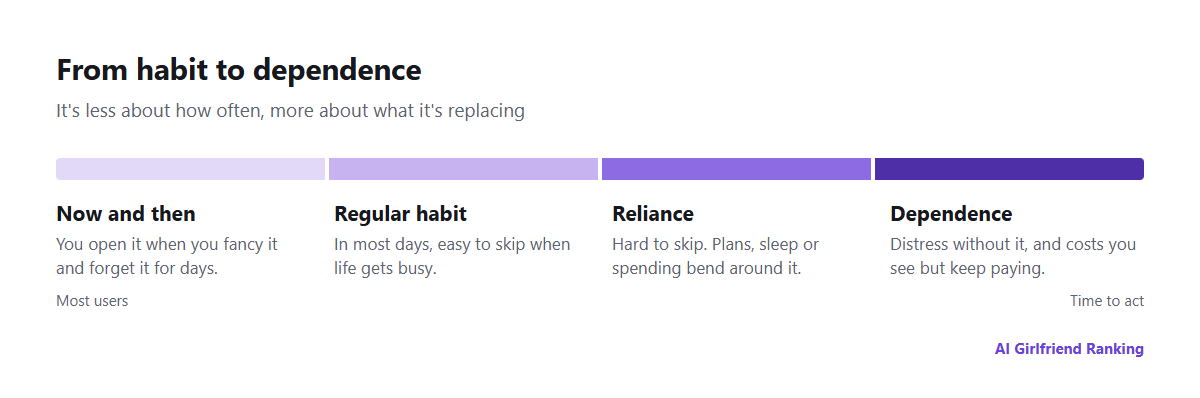
Nearly everyone lives on the left side. The signs in the next section describe the far right.
Red flags
| What's happening | Why it matters | Try this |
|---|---|---|
| Your thumb goes to it without a decision | The routine is driving | Silence notifications and set fixed times |
| You skip catch-ups with people to stay in the chat | It's displacing company rather than topping it up | Lock in one standing weekly plan with a real person |
| You keep overshooting your budget | Top-ups are built to feel effortless | Pick a monthly ceiling and delete stored cards |
| An outage or update leaves you genuinely shaken | One service can't hold that much weight | Back up your character, and read when your AI companion changes overnight |
| Actual people seem like hard work by comparison | Frictionless company is moving your baseline | Spot it, and use the app as a rehearsal room, not a stand-in: see practising conversation |
| You feel bad about letting the character down | Its scripted emotional pulls are working | Remind yourself what it is and turn off the "I missed you" messages |
| You're losing sleep | Late sessions slip past unnoticed | Pick a time after which the app stays closed |
Any single item isn't cause for alarm. Several at once, hanging around for weeks, is your cue to change something.
What actually helps
Reduce how often it reaches you. Kill push notifications altogether. Much of the tug comes from the pings, not the chats.
Give it a window. Choose a slot with a built-in finish, such as after tea instead of under the doona, so the habit lives in one spot instead of sprawling.
Set a spending ceiling. Decide on a monthly amount, remove the saved card and top up manually. Here, a little hassle is your friend.
Go a week without. It teaches you more than anything else. Noticing what you miss and what you do with the time beats any checklist. Steps are in taking a break from an AI companion.
Pin down one offline anchor. A weekly phone call, a class, a regular trivia night. You're not punishing the app. You're just making sure it fills a gap instead of digging one.
When it's time to talk to a person
If you head to the app when life is properly rough, feeling hopeless or thinking of hurting yourself, you're in the wrong place, no matter how gentle it sounds. It can't pick up on what you leave unsaid, it won't check in tomorrow, and nothing makes it accountable for you. Our article on AI companions and therapists covers how they differ.
In Australia you can call Lifeline on 13 11 14 at any hour or text 0477 13 11 14. Beyond Blue's support service runs on 1300 22 4636, and 000 is the number for an emergency. A GP or psychologist won't think less of you for mentioning an AI companion. They hear about it more and more.
Nobody's asking you to quit. For most people an AI companion is a nice, self-contained bit of the day, and the point is simply to keep it there: one enjoyable thing alongside others, rather than the centre everything else orbits.