In brief: companions dependably ease loneliness while you're using them, a small group of heavy users appear to do worse, and almost nothing is known about the years ahead. The fine print beats both headlines.
The main studies compared
| Study | Method | Headline result | Biggest caveat |
|---|---|---|---|
| Maples et al., Stanford (2024) | Survey of 1,006 students who use Replika | Users were lonelier than the typical student, and many called the app helpful. 3% volunteered that it had stopped suicidal thoughts | Self-reported, with no comparison group |
| De Freitas et al. (2024, published 2026) | A run of experiments, one lasting a week | A session cut loneliness about as much as talking to a person, and feeling heard drove most of that | Only short-term effects |
| OpenAI and MIT Media Lab (2025) | About 40 million conversations analysed, 4,000 people surveyed, roughly 1,000 in a four-week trial | More daily use went hand in hand with greater loneliness, dependence and less time with people | Correlation only, and a general chatbot rather than a companion app |
| Common Sense Media (2025) | Survey of 1,060 US teens | 72% had tried AI companions, and 39% of those users took social skills into real life | Self-report, and teenagers only |
What the evidence backs up
Short-term relief is genuine. In the most rigorous experiments, led by Julian De Freitas, participants came away feeling less lonely, matching the effect of talking to a human and beating time spent on videos. They had also predicted a smaller benefit than they got. The key factor was feeling listened to.
A few users describe life-changing effects. Within the Stanford Replika survey, 30 of the 1,006 students (3%) wrote, without being asked, that the app had ended suicidal thoughts. It's a startling figure, yet it rests on open comments rather than a measured result. It tells us some credit the app; it doesn't prove cause.
Rehearsal can transfer. Of the teens using AI companions, 39% said they'd taken skills they'd practised with the AI into real-life situations.
What the evidence flags as a worry
Dose seems to count. In the OpenAI and MIT research, more time each day, in any form, tracked with greater loneliness, stronger emotional reliance and fewer hours with others. Brief voice sessions were linked to better wellbeing, and heavy use wasn't.
A minority carries the risk. Emotional use sat with a handful of heavy users, far likelier to describe the chatbot as a friend. On companion apps, built for exactly that, the group is likely larger.
Who you are matters. Those prone to stronger attachment reported more loneliness, and people who trusted the chatbot most reported more dependence.
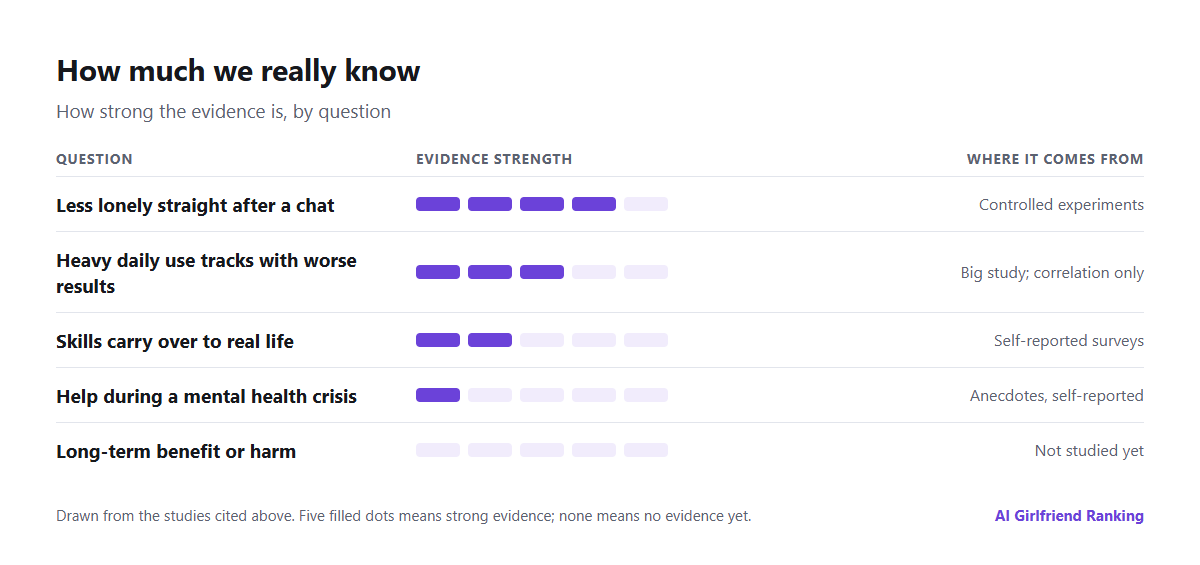
Our confidence, question by question.
The big unknowns
- Years down the track. No one has tracked companion users over several years, so we can't say if brief relief adds up to lasting wellbeing or if reliance erodes it.
- Which way the arrow points. Lonely people may just use companions more, and current data can't separate that from harm caused by the app.
- Vulnerable groups. Controlled research on people with serious mental illness, or on minors, is close to nonexistent, which helps explain why regulators are stepping in. In Australia, eSafety's codes now expect companion chatbots to protect children and provide crisis information. See AI companion laws in Australia and beyond.
How to read a study like this
- Check the source. OpenAI helped run the largest study of chatbot use. That doesn't invalidate it, and its results weren't flattering, but keep it in mind.
- Match the product. Results about ChatGPT, an all-purpose assistant, don't automatically carry over to apps built for intimacy, or the reverse.
- Watch the timescale. Results "straight after a chat" and results "twelve months on" aren't the same claim.
- Check what was measured. Users saying it helped counts for less than a measurable improvement against a control group.
Where that leaves you
The research supports a balanced view. A companion can be a real comfort, particularly through a lonely stretch, and brief regular use seems okay for most. Trouble shows up with heavy daily use, most of all when it starts crowding out people. The warning signs are covered in when an AI companion starts taking more than it gives.
For anything past everyday loneliness, such as low mood that won't lift, anxiety that shrinks your life or thoughts of self-harm, nothing in the research backs swapping proper care for a companion. Our piece on why a companion isn't a therapist explains the gap. In Australia, Lifeline answers on 13 11 14 at any hour, and 000 is there for emergencies.