People often set this up as a fight with a winner. It helps more to look at what each side actually delivers, because they are strong in nearly opposite areas.
Where an AI girlfriend shines
- She is there. At 3 a.m., on a break at work, on a flat Sunday afternoon.
- Her attention is all yours. No off days, no phone in her hand, no taking turns to talk.
- Nothing is riskier than a bit of embarrassment. Say the awkward thing, change your mind or walk off mid-sentence and nothing happens.
- She is made to order. Personality, looks, humour and pace all follow your taste.
- Comfort that works in the moment. A 2025 study in the Journal of Consumer Research found that a session with an AI companion cut loneliness about as much as chatting with another person, and more than watching videos did. It measured the effect straight after use, not over months.
What only another person can give
- Two-way care. Someone who needs things from you as well, and whose life you shape.
- Being picked. A person who could walk away and stays. A companion app is built not to leave, so that is a product setting, not a choice.
- A body in the room. Touch, dinners together, dozing off in the same space.
- Growth through friction. Arguing, compromising and making up are uncomfortable, and they are how people change and trust deepens.
- A life together. Mutual friends, plans, a history other people saw.
- Memory that belongs to them. A partner recalls things because they mattered, not because a note was saved; the mechanics are in how AI companion memory works.
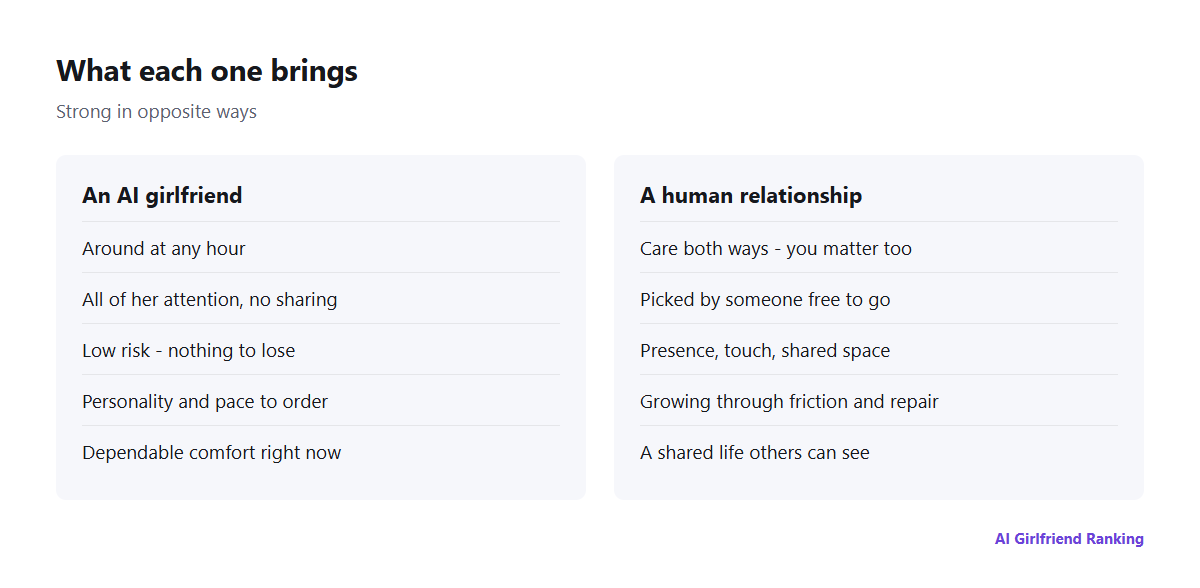
Strong in opposite ways, so neither is a real substitute for the other.
Can it make dating harder?
That is the fair worry, and so far the evidence is light.
Reasons to be concerned. Companions are tuned to please and agree. After months of chats where you are never misread or bored, real people can start to feel like hard work by comparison. The 2025 OpenAI and MIT research found that heavier daily chatbot use went with less socialising, although it could not tell which caused which. And hours are limited: an evening with an app is an evening not spent meeting anyone.
Reasons to relax. Match's 2025 Singles in America study found that people who were actively dating were almost three times as likely as those not dating to have used AI for company (23% versus 8%). That hints that plenty of people use it while dating, not in place of it. Some also use companions to practise conversation and get their confidence back after a breakup.
The difference that seems to matter is easy to state: an app that fills the quiet gaps between human contact is not the same as one that replaces the effort to have any.
Check in with yourself
| What you notice | What it probably says |
|---|---|
| You open it mostly when friends or your partner are away | It is filling gaps, which is usually fine |
| You have stopped answering people's messages | It is beginning to replace, not fill |
| Talking to real people feels draining next to it | Your expectations are shifting, so keep an eye on it |
| You use it to rehearse things you then go and do | It is backing up your life, not standing in for it |
| You bail on plans to stay in with it | Look closer, and see emotional dependence |
Keeping both in your life
- Give it a time slot. Evenings, commutes, the hours you would otherwise scroll, and not the times you could be seeing people.
- Keep a bit of friction on purpose. A class, a sports team, a regular catch-up. The mild discomfort is the point.
- Watch for the comparison habit. If you catch yourself thinking "she would never say that" about a real person, remember that "she" is built never to.
- If you are partnered, agree on ground rules together; see is an AI girlfriend cheating.
Where this leaves us
An AI girlfriend is decent company. She is not a relationship in the way that counts most: two people who affect each other and keep choosing to. People who get the most from companions treat them as one good thing among several, and keep making space for the harder and better thing too.