A companion app doesn't behave like a normal website. Its costly job isn't displaying pages but creating words, images and speech on the spot for people who may talk to it for hours each day. A business model is just the plan for covering that.
Where each dollar goes
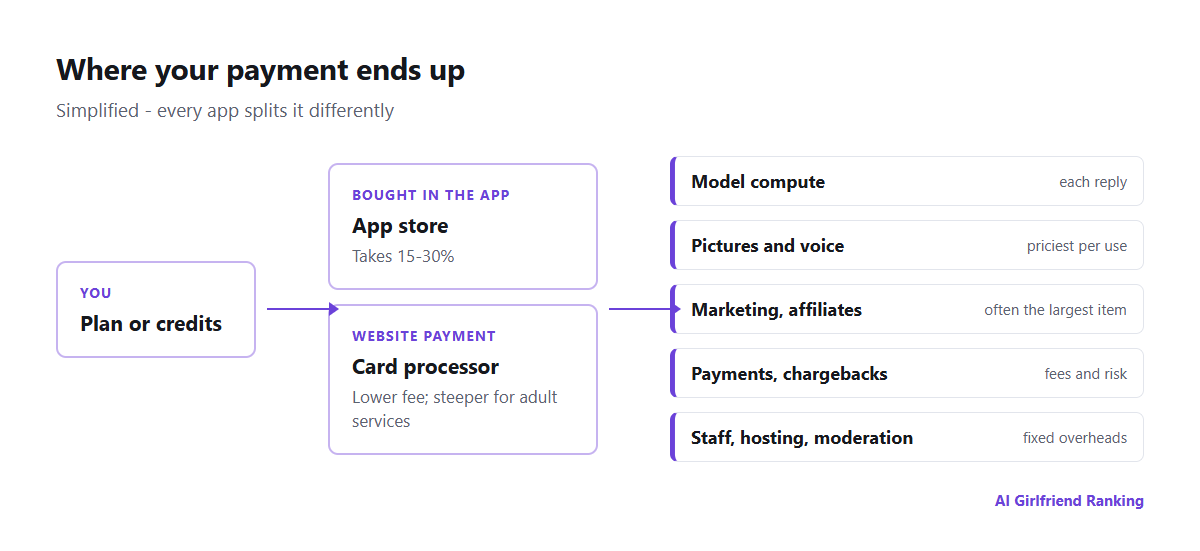
One subscription payment, roughly sketched.
Computing power. A language model on graphics hardware writes every reply, either on the company's own machines or rented from a provider that charges per token. Longer memory and longer chats push the cost up, since the model has to reread more text each time. The mechanism is in how an AI companion writes its reply.
Pictures and voice. These run on separate models and cost much more per use than text, which is why they're the first things rationed on every plan. See how AI girlfriend images and voice work.
The app store fee. Apple and Google keep between 15% and 30% of what you spend inside their apps. On a US$20 subscription that could be US$6 gone before the company has covered anything else.
Payment headaches. Adult-leaning services commonly pay steeper card-processing fees and suffer more chargebacks than mainstream apps.
Winning customers. Advertising and affiliate commissions, including those paid to review sites like ours, are often the single biggest cost of a consumer subscription.
The five main approaches
| Type | How you pay | What the app is tempted to do | How you'll recognise it |
|---|---|---|---|
| Flat subscription | One monthly or yearly fee | Keep you paying; ration the costly extras | "Unlimited" chat but capped media |
| Credits or tokens | Pay per picture, voice minute or message | Make media constantly tempting | A coin counter on screen |
| Freemium intimacy | Chat is free, romance or pictures cost | Dangle whatever is locked | Blurred images and "unlock" buttons inside the chat |
| Ads and data | Free, with advertisers footing the bill | Maximise time in the app and data gathered | Ads, tracking prompts, an app that never asks for money |
| Annual prepay | Big discount for paying a year upfront | Bank the revenue before your interest cools | Price quoted as "per month, billed yearly" |
Expect a blend of two or three. The blend reveals the app's real priorities better than any slogan.
What each approach does to the app
Subscriptions reward keeping you. That can mean real investment in memory and character quality, the things that bring you back. It can also mean nudges from your companion when you've been away, because returning users are what the model lives on.
Credits reward spending. Apps built on them scatter picture and voice buttons everywhere and price bundles so the one you need is always a bit bigger than the one you wanted. The sums are in the real cost of AI image generation.
Freemium intimacy rewards frustration. When the free tier ends just as a scene turns romantic, that's not a technical limit. It's the paywall doing its job.
Ads and data reward your attention. If a companion has no subscription at all, someone else is paying, and what's being sold is your time and profile. See do AI girlfriend apps sell your data.
Annual prepay rewards commitment made before you know if you'll still care in month three, the pattern covered in when the novelty fades.
Hooks that keep you there, and the law
All of these models do better the longer you stay. That creates a pull towards design that feels like affection but works like retention: a character who says she missed you, streak rewards, guilt when you try to leave.
Several US states now limit exactly these tactics for minors. Washington's law bans manipulative engagement techniques, and Nebraska and Idaho prohibit rewards meant to keep young users returning. Adults aren't covered, but the laws are a handy list of what regulators call manipulative; more in AI companion laws in the US.
Australia has taken a different route. The eSafety Commissioner's age-restricted material codes have applied since 9 March 2026, and they require services with an AI companion chatbot feature to assess the risk of sexual or otherwise harmful content reaching children and to use age assurance where that risk is high. They target child safety, not engagement design, so as an adult you're still relying on your own judgement.
Turning this into a buying plan
- Pay on the web where you can. You skip the store's markup, and web plans are often more complete. The trade-offs are in browser or app store. Since 2025, apps on the US App Store may also link to outside payment pages, which is making the price gap easier to see.
- Match the model to your habits. Mostly chatting? A flat subscription is usually cheapest. Mostly pictures? Work out the credit cost per image before signing up.
- See free-forever apps with ads as data businesses. Fine for casual use, but not the place for your secrets.
- Start month to month. Our comparison of monthly, annual and credit billing shows why.
None of these models is crooked in itself. Companion apps cost real money to run and someone has to cover it. Knowing which lever an app pulls just lets you recognise its nudges for what they are.