Affiliate marketing keeps nearly every site in this space running. The numbers are explained in how AI companion apps make money, which shows commissions as one of the largest costs an app carries. Understand how it works and you can take from a review what's useful and discount the rest.
Follow the money
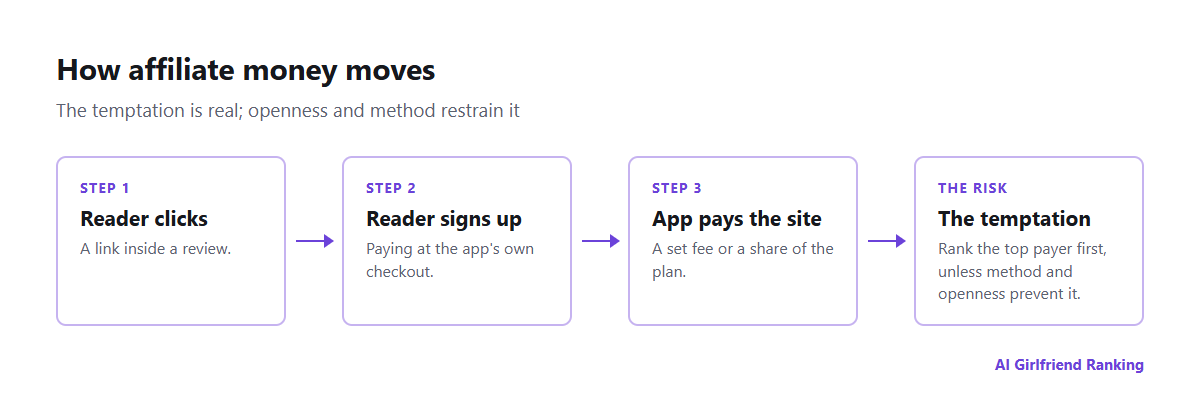
The temptation exists. Openness and a public method are what push back.
- Someone follows a review site's link and subscribes.
- The app pays the site a set amount or a share of the subscription, in some cases for as long as that person stays.
- The apps that pay more, or convert more visitors, earn the site more.
The incentive is plain: list the best payer first. Three things restrain it: disclosure, a testing method anyone can read, and a readiness to rank a paying app low if it tests poorly.
What Australian law says
Under the Australian Consumer Law, businesses can't mislead consumers, and the ACCC treats fake reviews and undisclosed paid endorsements as potentially misleading or deceptive conduct. The competition regulator has run sweeps of online reviews and influencer posts, and the most common problem it found was people not disclosing a commercial relationship. It also takes reports about fake or misleading reviews.
For context, the US has gone further on paper: since October 2024 the Federal Trade Commission's rule on fake reviews bans buying or selling them and undisclosed insider reviews, backed by civil penalties.
So a site that hides its commissions isn't just being unhelpful. It may also be on the wrong side of the law.
Signs someone actually tested the app
| What real testing looks like | What a reworded press release looks like |
|---|---|
| Precise episodes: "by day nine it had recalled..." | Blanket claims like "incredible memory" |
| Prices checked on a named date | Prices lifted from the app's homepage, often stale |
| Screenshots from within paid plans | Only promotional images from the app |
| Genuine complaints about the recommended app | Every app is "perfect for most users" |
| A method page showing how scores are set | Scores with no reasoning |
| Updated whenever the app changes | Untouched for years |
| Mentions of privacy incidents involving the app | Silence on anything negative |
Red flags
- Identical top three on lots of different sites, in the same order. They might really be the best, or they might pay the most.
- "Best of" lists full of apps the site never reviewed. Twenty apps ranked, none properly tested.
- Zero negatives. Every app in this category has trade-offs.
- Countdown timers and "exclusive" deals that never actually end.
- Reviews that read the same across different sites, a sign of shared copy.
Applying the same scrutiny to us
Everything above applies to this site. We disclose commissions on every page. The method (paid accounts, fortnight-long tests, five scores, hidden costs and privacy checks) is set out in how we test. Only apps we've tested make the ranking, and a few that we link to sit near the bottom. If something serious happens after a test, such as a privacy incident, we flag it; see AI companion data breaches.
Check for yourself anyway. Nothing protects you from a review, ours included, like a week of your own testing, and there's a plan in how to test an AI girlfriend app yourself.
Five-question checklist
- Is the commission disclosed right beside the recommendation?
- Is there a method page, and does the review follow it?
- Does it give specific, dated details that only real use could supply?
- Does it criticise the app it's recommending?
- Does it deal with privacy and not only features?
A review that ticks all five deserves a proper read whoever wrote it. One that ticks none is advertising, whatever label it wears.