The word "training" suggests software that slowly picks up your tastes, like teaching a dog. The reality is messier: a few actions alter behaviour at once, some shift it gradually for everyone, and some mainly give you a feeling of involvement.
What a reply is built from
Every reply comes from whatever the model can see at that instant, as laid out in how an AI companion writes its reply:
- The character's description and settings.
- Saved memories and summaries pulled in for this chat.
- The recent conversation.
- The base model, as the company last updated it.
Your feedback counts only to the extent that it alters one of those four.
Your tools, strongest first
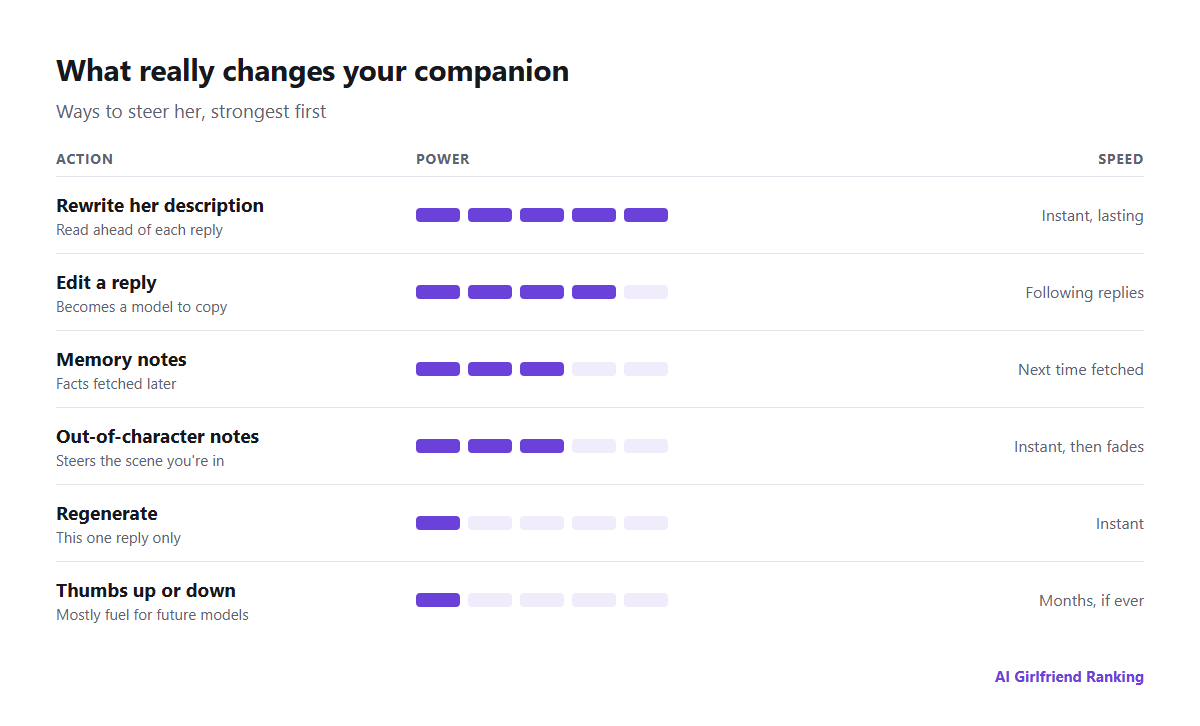
Change what the model reads, not what it feels about you.
| Action | What it touches | Speed | Power |
|---|---|---|---|
| Rewriting the character description | Instructions read ahead of every reply | Instant | Strong and long-lasting |
| Editing one of her replies | The chat history the model imitates | Following replies | Strong while it remains in view |
| Memory notes | Facts fetched into future chats | When next fetched | Strong for facts, weak for tone |
| Out-of-character notes | The scene you're in | Instant | Fades as the chat lengthens |
| Regenerate | That single reply only | Instant | Nothing beyond it |
| Ratings (thumbs, stars) | Usually material for future model updates | Weeks or months, if ever | Weak for your character |
Edit her, don't argue with her
Saying "you're not acting like yourself" in character rarely helps, because the argument becomes part of the chat the model copies. Rewriting her reply into what she should have said hands the model a good example. If your app lets you edit, make it a habit.
Tone in the description, facts in memory
- Tone, meaning voice, sentence length, humour and how affectionate she is, belongs in the character description, since it has to apply to every reply. Our character builder guide covers which boxes matter.
- Facts, such as your job, your dog's name or what happened last week, belong in memory, which is retrieved when relevant.
Mixing them up backfires: tone notes in memory get fetched unpredictably, and long fact lists in the description crowd out her personality.
What ratings are for
In most apps, ratings go into the company's pool of data for improving models, typically across all users. That's worth doing if you like helping future versions, but it isn't a direct line to your character. Some apps say ratings affect your companion specifically, yet even then the effect builds slowly and is much weaker than a rewritten description.
If it matters to you, read the privacy policy: rating a reply might flag that chat for review or training, which is a privacy trade-off. See who reads your AI companion chats.
A weekly tune-up
- Jot down two things you enjoyed and one that grated this week.
- Turn the grating one into a positive instruction in the description ("She replies in short, dry sentences" beats "Don't ramble").
- Add any important new facts to memory.
- Begin a fresh chat if the old one has drifted, because long conversations gather habits, as personality drift explains.
She doesn't get to know you the way a person does. But she reads you each time, through her description, her memory and your latest words. Change what she reads and you change who she is.