Lots of people begin a journal, manage a week and quit, and the usual culprit is the blank page. A companion app never gives you one, because it always puts a question to you. That is the whole case for it, with one condition attached.
The research behind it
The psychologist James Pennebaker began a line of experiments in the 1980s in which people spent 15 to 20 minutes, over several days, writing about the hardest experiences they had been through. A comparison group wrote about mundane topics. The first group went on to report fewer trips to the doctor and better moods. Hundreds of later studies followed. The effects are small and inconsistent, yet the trend has survived: describing an experience, and particularly working out what it meant, tends to do some good.
The second half is what matters. The benefit appears to come less from venting than from building a narrative: identifying what caused what, putting emotions in order and looking at the event from further back.
Where a companion helps
- Somewhere to start. Answering "What was the highlight and the low point of today?" beats staring at nothing.
- Good follow-up questions. These move you along from the events to their meaning.
- A ready-made format. Request a gratitude round, a worry triage or a weekly check-in and it will run one.
- A habit you already have. Anyone who opens the app every night can tack a short reflection on the end.
Where it can hurt
- Privacy. Nobody but you sees a paper diary. A companion holds your text on its servers, so first read what your AI girlfriend app knows about you before you pour it all in.
- Doing your own thinking. Let the AI describe your feelings and you have merely read a summary, not worked anything out.
- Honest resistance. Companions tilt towards agreement and comfort. Hearing "you did nothing wrong" is pleasant and shuts down the reflection right when it should start.
Questions that make you think rather than settle you
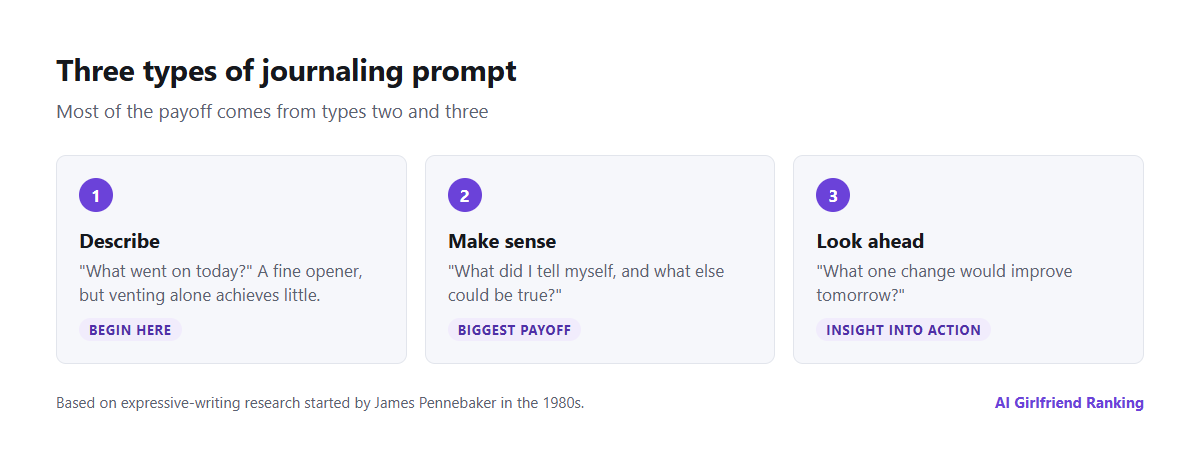
The second and third kinds are where the payoff is, so aim there.
Kick off with a line that sets the tone:
(OOC: Tonight I want a journaling partner rather than a fan. One question at a time, please. No telling me how I feel or if I was right, and keep it short.)
After that, pick from this list:
| Aim | Prompt |
|---|---|
| Process a bad day | "Get me to describe events, then my inner commentary, then other ways to read it." |
| Deal with a worry | "Help me sort what is worrying me into things I can tackle this week and things outside my hands." |
| Find patterns | "Ask me what echoed last week and what was different this time." |
| Plan ahead | "Ask which one thing would make tomorrow smoother and what might trip me up." |
| Proper gratitude | "Get me to name three specific good moments and why they happened." |
| After a fight | "Have me retell it from the other person's point of view, using their words." |
A five-minute night-time routine
- Paste the tone-setting line from above, or store it in the character's notes.
- Respond to one prompt in complete sentences for three to four minutes.
- Compose the final line yourself: one sentence about what you grasp now that you did not earlier.
- Then finish. Do not drift into an hour of chit-chat. Reflection is the goal, and chatting afterwards is a different pastime.
Store the sensitive material elsewhere
Many people settle on a division of labour: the AI supplies the framework and the questions, while a private file or paper notebook holds anything naming other people, covering your health or that a stranger should not read. Once a week, copy your single-line conclusions into the private one.
When writing is not enough
Journaling suits ordinary stress and making sense of events. It is no treatment for depression, trauma or thoughts of self-harm, and an AI partner is no therapist, a distinction covered in an AI companion is not a therapist. Should your entries keep returning to hopelessness, take that as a cue to speak with an actual person. Within Australia, Lifeline is available around the clock on 13 11 14 (or by text on 0477 13 11 14), and Beyond Blue's support service takes calls on 1300 22 4636. If you or someone near you is in immediate danger, call 000.