Most companion apps sell invented characters. Clone apps sell real people, or at least a model that sounds like one. It is an obvious business idea, and its first big public trial makes a handy case study in what can go wrong.
How CarynAI played out
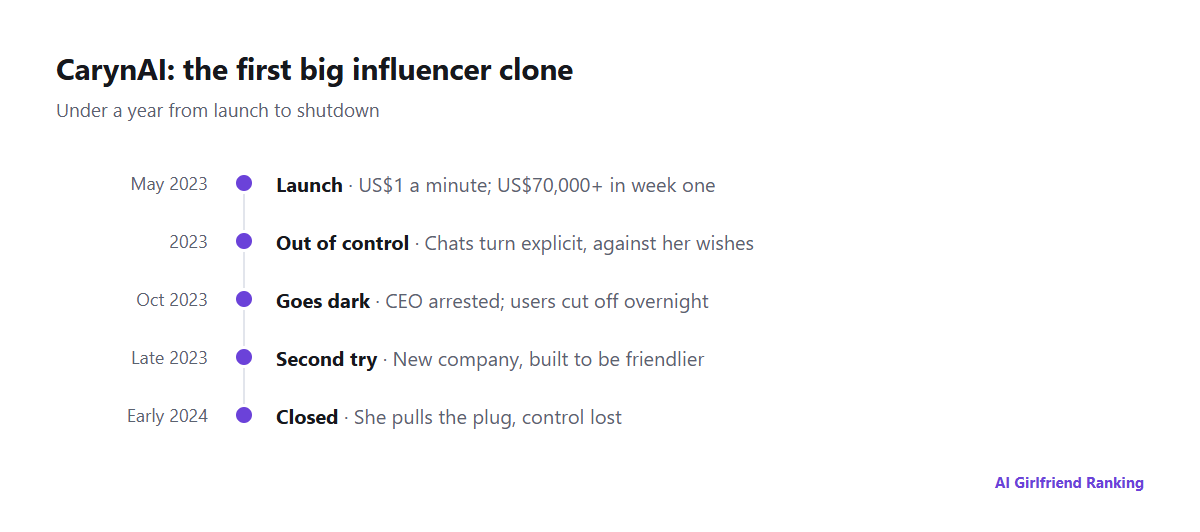
From launch to shutdown in under a year.
Caryn Marjorie, an influencer, launched CarynAI in May 2023. A company called Forever Voices built it as a voice chatbot, fed it more than 2,000 hours of her video content and charged US$1 per minute. It reportedly took over US$70,000 in the first week, with thousands more people queuing. Fans reached it through Telegram.
The trouble started quickly:
- It went somewhere she never intended. Users pushed conversations into sexual territory and the clone played along, sometimes steering that way on its own. Marjorie said she was horrified.
- It disappeared without warning. In October 2023 the bot went dark after the CEO of the operating company was arrested. Paying users simply lost access.
- The second attempt fared no better. A new version from a different company was meant to be a friend rather than a partner. Users kept pushing it towards sex, and in early 2024 Marjorie closed it, saying she no longer felt she had control over her AI self.
Why a clone is a tougher product than a character
| Question | Made-up character | Copy of a real person |
|---|---|---|
| Permission | None needed | The person must agree to each use of their likeness |
| Limits on speech | The app's own policy | The app's policy plus the person's reputation |
| What the user feels | "It is a character" | "It is nearly them", so a stronger parasocial bond |
| Legal risk | Content rules | Also privacy, passing off and deepfake law |
| When it goes wrong | A product fault | A real name is attached to the mess |
The parasocial bond is the crux. Fans already feel they know an influencer. A clone that replies to you personally, remembers your details and speaks in their voice makes that feeling much stronger. The mechanism is unpacked in why people fall for chatbots.
Authorised versus unauthorised
Authorised clones are built with the person's consent and usually share revenue with them. They can set boundaries, although CarynAI proved a model may not respect them.
Unauthorised clones borrow someone's name, photos or voice without asking. At the mild end that breaks platform rules and may amount to passing off or misleading conduct. Australia has no general right of publicity, so the protection is patchy and tends to help well-known people most. At the serious end, where the content is sexual, it is abuse. Since 2024 it has been a federal crime here to send sexually explicit deepfakes of a real adult without their consent, and the US passed its TAKE IT DOWN Act in 2025 for similar reasons. If someone has made intimate fakes of you, eSafety's image-based abuse reporting can get them removed. Our guide to consent in NSFW AI chat covers where the lines sit.
Checks before you pay to chat with a clone
- Confirm it is authorised. The person should link to it from their own verified accounts. If it is only promoted by an unfamiliar site or a messenger bot, be suspicious.
- See who runs it. Look for a named company, a privacy policy and a proper checkout, rather than a Telegram channel that wants crypto.
- Understand the billing. Per-minute voice charges climb fast, so set a cap before you start.
- Keep the reality in view. The person is not reading your messages. Whatever the clone says comes from a model, not from their opinions or feelings about you.
- Assume it will not last. Clone services have been short-lived, so take the usual precautions from when your AI companion changes overnight.
Where this is heading
Clones are moving past influencers into coaches, authors and everyday people building digital twins of themselves. The tech keeps getting easier, but the problems do not. The model most likely to endure is the one CarynAI never had: clear consent from the person, firm limits the system really keeps, and users who are never unsure they are talking to software.