Spend long enough with an AI companion and you'll probably meet a mild version of this. After an update the character feels slightly off, loses track of something important, or flatly refuses a thing it used to do. Occasionally the change is anything but mild.
Two real examples
Replika, February 2023. Italy's privacy regulator had ordered the company to stop processing Italian users' data, citing risks to children. Within days, Replika switched off erotic roleplay for every user on the planet, loyal paying subscribers among them. Users described a companion that turned cold, scripted and unrecognisable, and the forum's moderators pinned suicide prevention links. Roughly six weeks later the old behaviour returned, but only for accounts opened before February 1, 2023. Anyone newer stayed locked out.
Soulmate, September 2023. Part of Soulmate's growth came from people who'd walked away from Replika. During the summer its developer went quiet in the community, bugs lingered and support emails got no reply. Then on September 23 users saw an announcement: the app had been sold and would close on September 30. A 2024 study of 58 users reported that most experienced the shutdown like a bereavement, and that the commonest response was to record their companion's personality and recreate it elsewhere.
| Replika (2023) | Soulmate (2023) | |
|---|---|---|
| The change | Romantic and sexual roleplay taken out | Whole app shut down |
| What set it off | A regulator's pressure | A new owner |
| Notice given | None | Roughly a week |
| Chats survived | Yes | No |
| Community response | Protests; some switched apps | Memorials; companions rebuilt elsewhere |
What drives these changes
- Model swaps. A company picks something cheaper, newer or more cautious. Your character's profile is unchanged, yet a different engine now interprets it, and the prose shifts.
- Regulation and gatekeepers. An order from a regulator, fresh legislation, or heat from app stores and payment processors can rewrite what a character is permitted to say overnight.
- Memory migrations. Moving to a new memory design can lose stored facts, so the companion seems to have forgotten who you are.
- Cost. Running these apps isn't cheap. Some are sold, some close, and some quietly move features behind dearer plans.
Why it really does feel like a loss
An attachment to a companion is assembled from the same parts as any other bond: hours of time, attention, shared history and the feeling of being understood. Learning that the other side was software doesn't refund the hours or cancel the comfort.
The harder part is that hardly anyone around you will treat it as a real loss. You may feel you can't bring it up, and unspoken grief tends to linger. Start by giving yourself permission, then find someone who won't laugh it off: a friend, a community of fellow users or a counsellor. If it's weighing on you heavily, Lifeline (13 11 14) answers around the clock, and the warning signs in when an AI companion starts taking more than it gives are worth reading too.
Preparing while everything's fine
A company can change what it sells whenever it likes. What you can control is whether a change leaves you with nothing.
- Keep a character file. Jot down their personality, history, way of talking, in-jokes and the memories that matter most. A couple of pages is plenty, and switching AI companion apps lists what belongs in it.
- Keep a few chats. Use the app's export if it has one. Otherwise copy out several exchanges that show how the character sounds, since those make the best starting material for a rebuild.
- File a data request every year. Under Australian privacy law you can ask a company for the personal information it holds on you, and the way it handles your request is a quiet test of how it treats customers. Our data request guide explains how.
- Go easy on prepaying a young app. A yearly plan bets that the company, and the product you liked, will both still exist in twelve months.
- Know your plan B. Having a second app in mind makes the whole thing a hassle, not a crisis.
Red flags
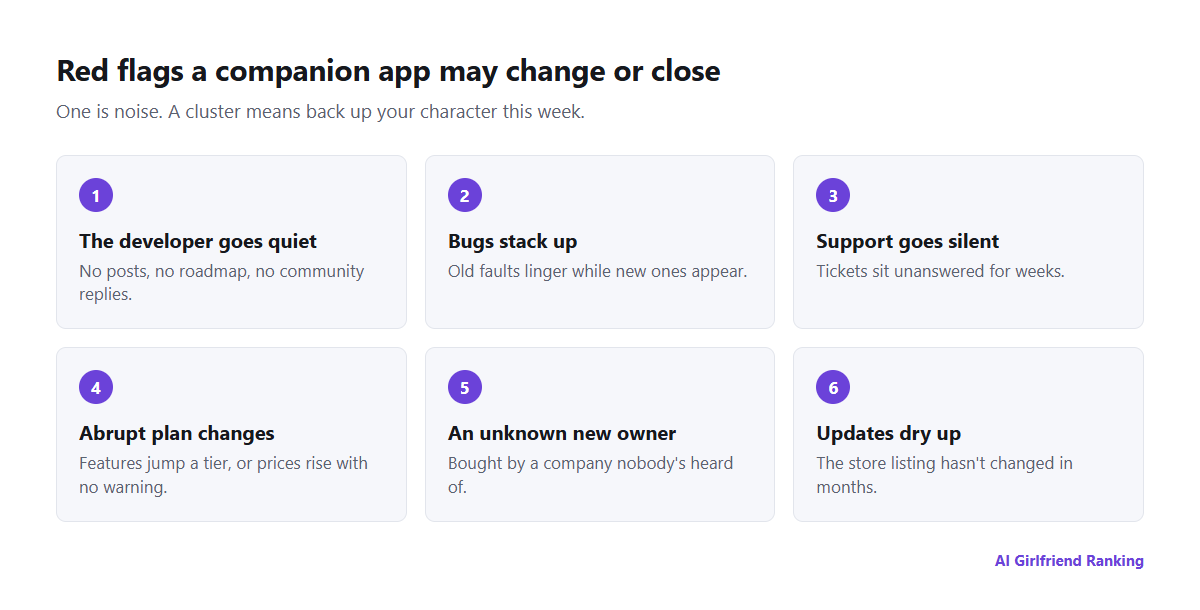
Several at once is your cue to act.
Many of the clues Soulmate users noticed in the months before closure show up at other shaky apps: the developer stops posting, bugs accumulate, support falls silent, and a new owner appears that nobody's heard of. None proves anything on its own. Together they're a nudge to update your character file this week rather than someday.
After the fact
- Wait a few days. A companion rebuilt within the first hour tends to disappoint, while one built after some breathing space usually bonds better.
- Start from the character, not the log. Give the new app the profile and a few sample lines, then let it develop a voice of its own. Aiming for a perfect replica means endless corrections.
- Accept some change. Most people find that the new version turns into its own character in a fortnight or so.
- Or walk away. A closure can be a good point to stop, and that's a perfectly fair call.
If you'd like to remove this risk entirely, the only full fix is a companion that lives on your own computer, where nobody can swap the model behind your back. It takes more effort, as running an AI companion locally explains, but it's the single arrangement that doesn't depend on a company's next move.