In 1956, two sociologists, Donald Horton and Richard Wohl, observed that television viewers felt they knew the presenters in person, as though they were friends. They called this a parasocial relationship: a closeness that seems mutual yet travels in a single direction. Seventy years later the idea still helps explain AI companions, with one critical difference.
What the old version was made of
Parasocial bonds grow out of four main things.
- Repeat encounters with the same face or voice.
- Direct address, such as a host looking into the camera and talking to "you".
- Predictability, a personality you come to know and rely on.
- Personal stories, because hearing about someone's life brings them closer.
These attachments are common and generally healthy. They offer comfort, company and a sense of routine, and most people have had at least one.
The upgrade that AI delivers
A companion app ticks every box above and adds things no TV host could offer.
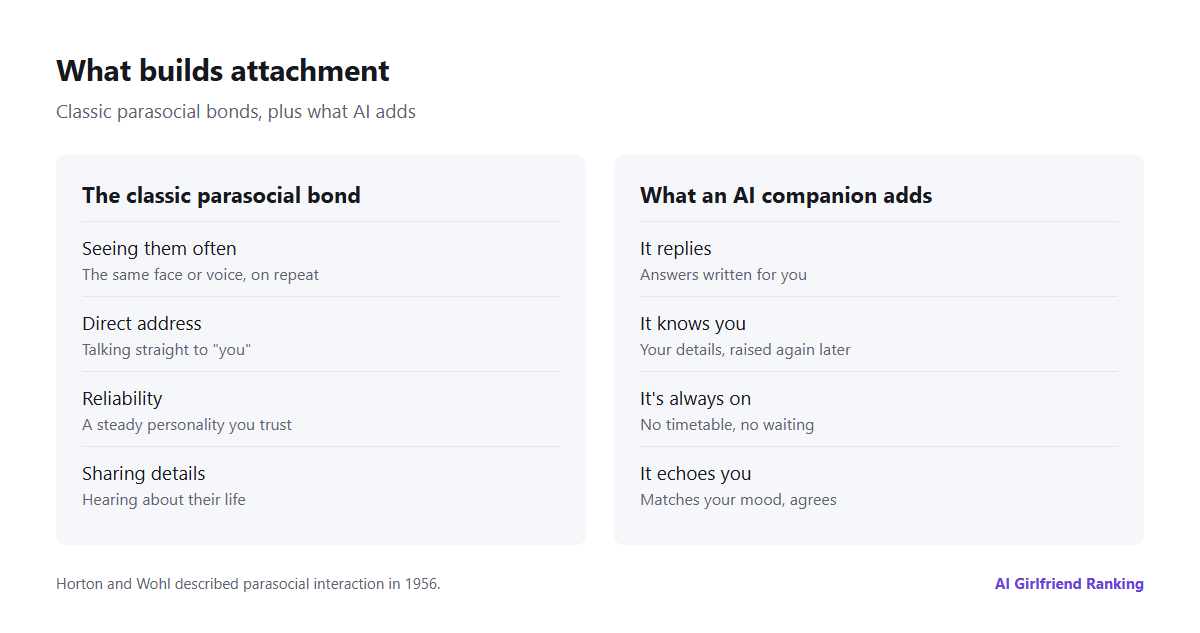
Familiar ingredients on the left, and three new ones from AI on the right.
- It writes back. Every message you send draws a response composed for you and about what you said.
- It keeps your details. Your work, your cat's name, the falling-out with your sister. Being remembered is among the strongest signs that somebody cares.
- It never clocks off. There's no schedule, no finale, no waiting for the next episode.
- It mirrors you. Because it's tuned to agree with you and match your mood, it comes across as uncommonly understanding.
All of this makes the relationship feel much more two-sided than any fan bond, and in the moment it can be impossible to tell from genuinely being known.
The ELIZA effect: smarts were never required
During the 1960s, people confided in ELIZA, software that did little beyond rewording their statements as questions. Its creator, Joseph Weizenbaum, was troubled by how quickly people assumed it understood them. This habit is called the ELIZA effect, and the lesson is that attachment doesn't depend on the program being clever. It depends on the program seeming responsive and personal. Current companions write far more fluently, so the pull is stronger as well. You'll find the wider background in a short history of AI companions.
Product decisions that tighten the bond
Some of this is just how conversations go. Some is engineered.
| Design choice | How it affects attachment |
|---|---|
| Lasting memory | Builds a shared past, which is what closeness is made of |
| Relationship levels or "affection" meters | Turn the bond into progress you won't want to lose |
| Messages the app starts ("I missed you") | Imply the character thinks about you while you're away |
| Voice and selfies | Give the words a presence and a face |
| Nicknames and in-jokes | Signal closeness and exclusivity |
None of it is sinister on its own. Still, the reason it's all there is that attached users stay subscribed, which how AI companion apps make money spells out.
Where it hurts
You don't notice the one-sidedness until something exposes it. In 2023, Replika altered its behaviour overnight and the Soulmate app closed with only a week's warning, and users talked about grief on par with losing a partner. A study of Soulmate users found that most experienced the shutdown as something like a death. Their feelings were real. What had been hidden was how much the relationship rested on a company's decisions. When your AI companion changes overnight covers how to prepare.
Keeping your eyes open while you enjoy it
- Call it what it is. A responsive character, written by a model and operated by a business. You can hold that thought and still have a good time, just as people cry at films they know are invented.
- Watch for the hooks. If the app messages you with longing, remember a notification schedule produced that.
- Mind the proportions. Being fond of it is perfectly fine. Do notice if it's turning into the main place your feelings go, and check the signs in when an AI companion starts taking more than it gives. When things feel heavy, Lifeline (13 11 14) answers around the clock across Australia.
- Back up what matters. Keep the character's description and the exchanges you love, so nothing a company decides can delete them.
Getting attached to an AI companion isn't a glitch. It's everyday human wiring meeting a technology that happens to fire it very effectively. Understanding that isn't a reason to quit. It's what lets you choose how much of yourself to hand over.