Adding anything to plain text makes the companion feel more present. A voice, a face, a body in your lounge room, and one day touch. But every addition also brings a bigger price tag, more moving parts and more of your data going somewhere. The 2026 picture, format by format:
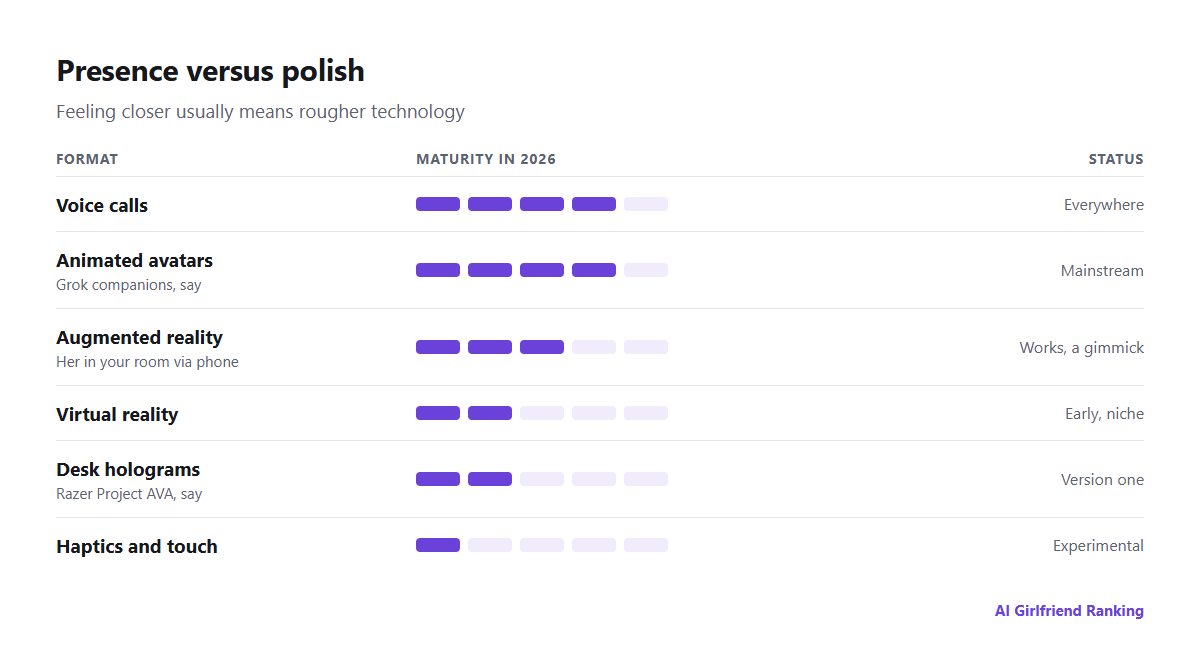
The more it feels like a real presence, the less polished it tends to be.
Talking and moving on a flat screen
Animated avatars are the format most people meet first. A cartoon or 3D character on your phone blinks, gestures and lip-syncs while it speaks. xAI brought this to the mainstream in July 2025 by adding companions to Grok: an anime-styled woman, a cartoon red panda, voices, and an "affection" score that opens up new behaviour the higher it climbs. It made avatars a household topic, and caused a row about what the higher levels allowed.
Where it stands: well developed and widely offered.
Seeing her in your room through the phone
Augmented reality places the character on your floor or couch as seen through the camera. Replika has offered this for years. Most people try it once, enjoy it briefly and move on, but it shows the goal: a character in your space rather than trapped in a rectangle.
Where it stands: you can use it today, though it is mostly a party trick.
Sitting across from her in a headset
Inside a headset you can share a table, go for a walk or hang out in a virtual place with an AI character. Several VR apps and social worlds have them. Reality intrudes quickly, though. Headsets are uncomfortable after an hour, the bodies move like puppets, and once you have run out of chat there is little to do.
Where it stands: genuine but early, and used by a small crowd.
A character on your desk
Some products put the character in a little gadget that projects her without a headset. In Japan, Gatebox sold one from the late 2010s, marketed as someone waiting to greet you after work. Razer's Project AVA, shown at CES in January 2026, is a 5.5-inch animated hologram in a cylinder that has a camera, microphones and a menu of characters. It was announced with xAI's Grok inside and a planned shipping window in the second half of 2026.
Where it stands: version-one products, so prices and features are bound to change.
Feeling her touch
This is the hardest problem by far. Vests, gloves and connected gadgets can produce pressure or buzzing, and some adult toys can be controlled from an app or by a chat. None of it is remotely convincing. You get a cue that suggests touch, not what a person feels like.
Where it stands: still experimental, with a small market in adult products.
What a device in the house knows about you
| Phone chat app | Companion gadget | |
|---|---|---|
| Microphone | Live only when you use it | Often on standby for a trigger word |
| Camera | Rarely involved | Commonly included, to make eye contact and read gestures |
| How close it sits | Something you pick up and put down | A fixture in the room |
| What it may learn | Your typed words | Voice, face, daily routines, the room itself |
| Turning it off | Close the app | Look for a hardware mute and a camera cover |
If you are about to buy something with a camera and a microphone, get answers first. What is analysed on the unit versus sent to servers? Is there a physical mute? How long are recordings kept, and can you delete them? The advice in what your AI girlfriend app knows about you applies twice over.
What comes next
Expect steady growth in presence, chiefly through voice and animated characters, driven by the largest tech companies, which we look at in what Big Tech is doing with AI companions. Voice is where the real gains are today, as AI companion voice calls explains. Headsets and holograms will improve, yet in 2026 the most immersive thing on offer for most of us is still a phone call with a character who remembers us.