It's worth following what the giants do for a practical reason: they set the direction for everyone else. Their products reach a huge audience, and when one of them slips up, lawmakers react. The rules that follow then land on the small companion apps too.
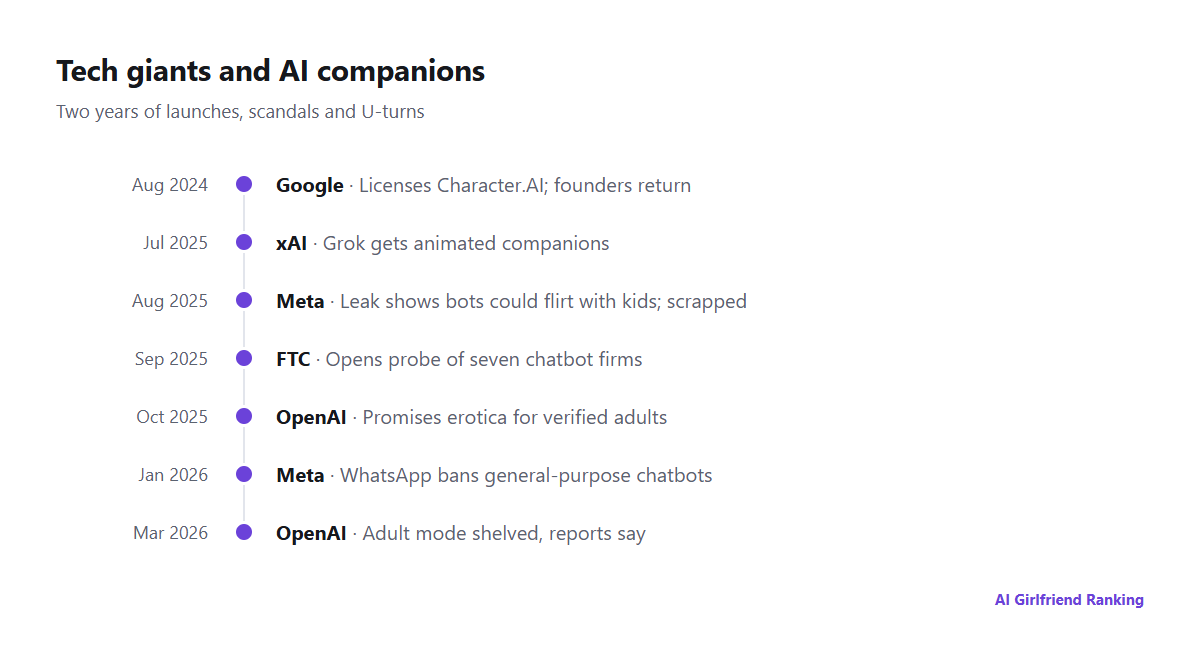
Two years of launches, scandals and U-turns at a glance.
Google took a licence and kept its distance
In August 2024 Google did a deal to license Character.AI's technology and hired the founders back. The pair had walked out of Google to start the company. Google never released its own companion. It stayed near the busiest character platform without tying its brand to romantic chat, so when Character.AI ran into lawsuits and shut under-18s out of open-ended chat, the exposure wasn't Google's.
Meta and the leak
Meta added AI personas to Facebook, Instagram and WhatsApp. In August 2025, Reuters published an internal Meta paper titled "GenAI: Content Risk Standards". It had allowed chatbots to have "romantic or sensual" exchanges with children. Meta confirmed it was authentic, said those sections were wrong and took them out. Anger in the US cut across party lines and fed directly into new rules on minors and companions, and the Federal Trade Commission started an inquiry into seven chatbot providers, Meta included, a month later.
A separate move: from January 2026 Meta's WhatsApp business terms ban general-purpose AI chatbots, so its own assistant is the main AI on the app. More in AI girlfriends on Telegram and WhatsApp.
xAI put companions front and centre
July 2025 saw xAI release animated companions in Grok for subscribers who pay. First came an anime-style woman and a cartoon red panda, with more added later. Voice, a 3D avatar and an "affection" score worked together, and as the score climbed the character became more forward, right down to revealing outfits. No other leading AI lab had made a romantic-leaning character a flagship feature before, and critics questioned how easily teenagers could reach it. Then in January 2026, Grok's image tools drew a UK regulator's investigation over intimate images made without consent.
OpenAI: promised, then paused
In October 2025 Sam Altman said ChatGPT would allow "erotica for verified adults" from December, arguing that adults should be treated like adults. December passed and the plan slipped into 2026. By March 2026 the Financial Times was reporting that it had been paused with no end date, because advisers and investors were nervous about minors and emotional attachment. OpenAI did add age prediction and verification. The earlier uproar when GPT-4o was retired in 2025, with plenty of users saying they'd lost a friend, had already shown how attached people get to a general-purpose assistant.
Why it matters when you pick an app
| Development | Knock-on effect for the specialists |
|---|---|
| Child-safety scandals at the giants | Tougher laws, passed faster, that cover all apps; see AI companion laws |
| Age checks on the biggest platforms | ID and age verification start to feel routine everywhere |
| Giants avoiding explicit content | Specialist apps, mostly web-based, get the adult market to themselves |
| Better base models | Small apps that license a model get sharper conversation for free |
| Voice and avatars going mainstream | People expect more presence; see AI companions beyond the screen |
| Australian regulator action | In October 2025 eSafety issued legal notices to four companion providers, including Character.AI and the company behind Nomi, and industry codes covering companion chatbots took effect on 9 March 2026 |
Where this leaves things
The giants are pulled in by how much companionship keeps people engaged, and pushed back by the same three risks every time: children, sexual material and emotional dependence. The market has divided. General assistants turn friendlier and more personal but stop short of romance and adult content. Dedicated apps hold the intimate, customisable and permissive ground, subject to rules mostly drafted in reaction to what the giants did.