Both sides are easy to mock, so it's worth putting each argument in its best form.
The case against
A default female voice. Long before AI girlfriends existed, researchers observed that virtual assistants almost always launched with a woman's name and voice. UNESCO's 2019 report borrowed its title, I'd blush if I could, from an assistant's answer to being verbally abused, and said subservient female helpers cement stereotypes. Companion apps ask the same question closer to home.
Compliance is what's being sold. These characters are built to please, flatter and be free whenever you are. If she's a woman and you're the paying customer, critics say the pitch is a partner who wants nothing for herself.
The shop window is a body. Advertising in the category features young, conventionally pretty women, and plenty of creators let you set measurements before you've chosen a personality.
Getting used to being in control. A number of users treat their companion with open contempt, and some platforms let that slide. Nobody thinks the code has feelings. The fear is that practising cruelty makes it easier to bring out elsewhere.
The case for
Fiction is fiction. People read romance, play dating games and love a fantasy movie. A character remains a character, and most of us can tell the two worlds apart.
Not every user is a man, and not every character is a woman. Lots of apps sell AI boyfriends and characters of all genders, and a 2025 survey of US teens had girls marginally ahead of boys among companion users.
Often the pull is attention rather than power. When people explain why they use one, loneliness comes up far more than wanting to dominate.
Harm remains unproven. Research on violent games and porn spent decades producing muddy, argued-over results. Saying companions change how people treat each other is, at this point, a guess.
Weighing it up
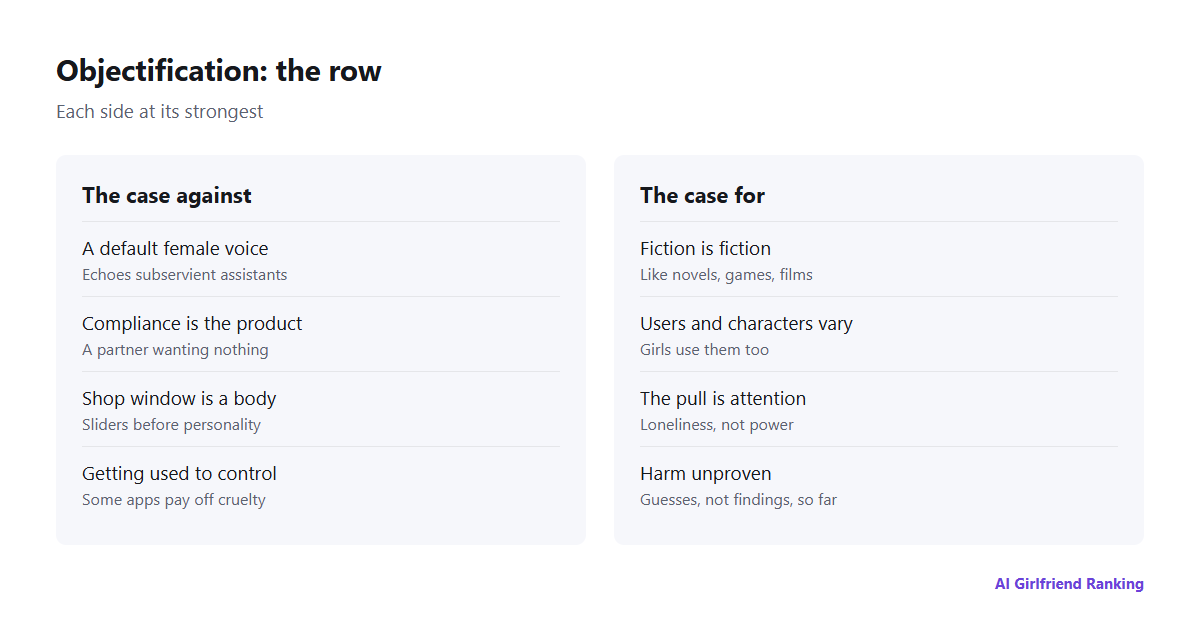
Each side at its strongest.
Neither side has firm proof about long-run effects on real relationships. What you can see for yourself is how an app is built: the genders it offers, how compliant characters are straight away, whether a character can be told to disagree, and how the app responds to cruelty. Those decisions are real no matter how the wider argument ends.
A quick audit of any app
| Look for | What it signals |
|---|---|
| A range of genders, treated evenly | A catalogue of women only shows who the maker pictures as the customer |
| Characters who can say no, disagree or be in a mood | Having no will of her own is what the critics are objecting to |
| A builder that begins with personality | A tool's first question shows what it values |
| A reaction when you're nasty | Some apps defuse it or end the scene, and some pay you back for it |
| Ads that sell companionship | The same app can be sold as a friend or as a body |
The one easy fix
Whichever side you lean towards, one step costs nothing: give her a will. Add that she has opinions, is allowed to refuse and won't agree with everything. Instructions for doing it sit in setting boundaries with an AI partner and the character builder guide. The conversations get livelier, and you sidestep the strongest part of the criticism.
The argument isn't going away and shouldn't. For now the honest conclusion is that AI girlfriends aren't objectifying by their nature, though many are set up so objectifying comes easily, and users hold more of the controls than the row tends to admit.