Every new generation of companion tech arrives with the pitch that this time the machine really understands you. What's more interesting is that people got attached each time, even when the software understood nothing whatsoever.
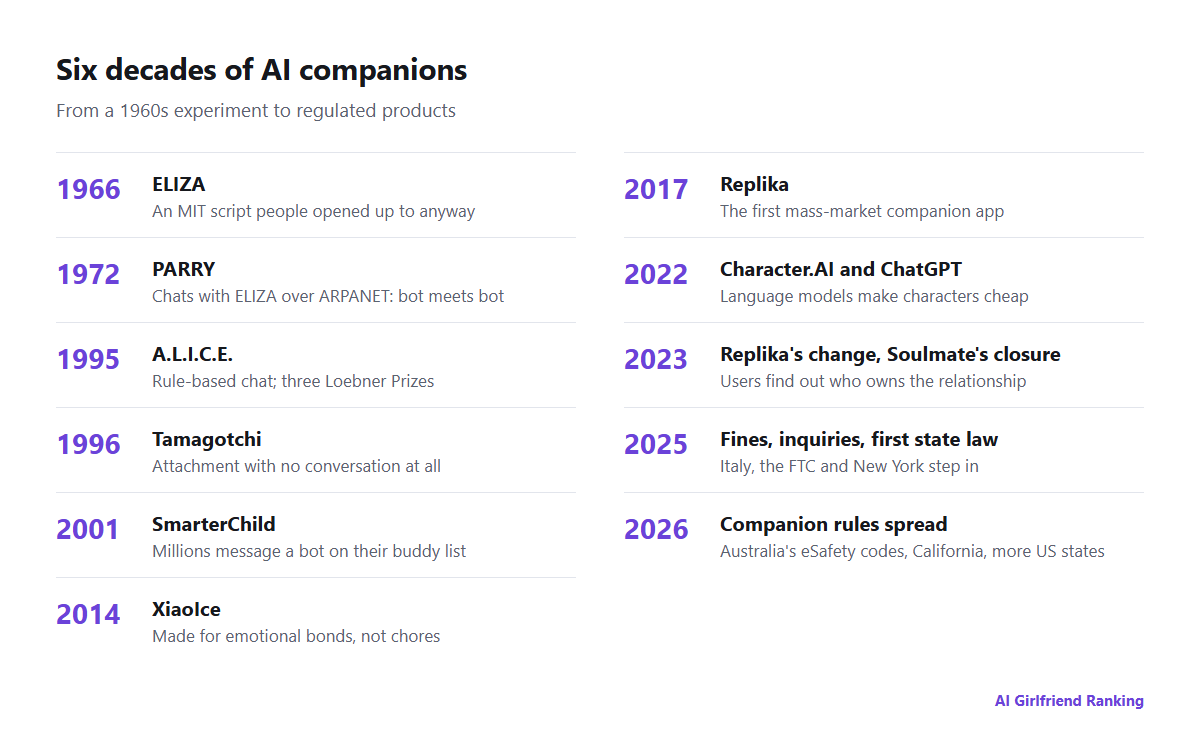
Six decades, eleven markers.
1966: a lab demo that people took personally
Joseph Weizenbaum's ELIZA, built at MIT, was meant as a demonstration of how little effort it takes to seem like you're holding a conversation. The best-known version, DOCTOR, acted out a therapist, and its trick was turning whatever you typed into a question. No comprehension was involved, just pattern matching and word swaps.
Users opened up to it all the same. Weizenbaum recalled that his secretary once asked him to leave so she could have privacy with the program. That habit of finding a mind inside something that's simply echoing you is now known as the ELIZA effect. It's a better guide to today's apps than any benchmark, and Weizenbaum spent a large part of his career warning people about it.
1972 to 2013: rule-based bots, digital pets and buddy lists
In 1972, psychiatrist Kenneth Colby at Stanford released PARRY, a program that imitated a patient with paranoid schizophrenia. It was hooked up to ELIZA's DOCTOR across ARPANET that year, which may well be the first time two bots talked to each other.
Richard Wallace's A.L.I.C.E. (1995) was written in a rules language called AIML. It won the Loebner Prize, a Turing-test-style contest, on three occasions, and thousands of hobby bots were built using its rules.
The Tamagotchi (1996) couldn't say a word, and yet children around the world cried when one died. The lesson was that attachment runs on routine and feeling needed. Intelligence doesn't come into it.
SmarterChild (2001) sat inside AOL and MSN contact lists. Teenagers by the million messaged it in between chats with their real friends, largely just to see what came back.
Microsoft's XiaoIce (2014) in China was the first major product aimed at emotional connection instead of getting tasks done. Microsoft reported hundreds of millions of users. It was an early hint that people return for company far more than for usefulness.
2017: Replika turns it into a product
Replika began as a tribute. Roman Mazurenko, a close friend of Eugenia Kuyda's, died in 2015, and she trained a chatbot on his messages so the conversation could carry on. In 2017 her company Luka put out a public version where anyone could raise a companion that learned from their own chats.
The first releases mixed scripted lines with a neural model, and they were fairly limited. Even so, they laid down a blueprint that nearly every app still follows: one lasting character, a relationship status, memories of your life, and a subscription that unlocks romance.
2020 to 2022: language models rewrite the economics
With GPT-3 in 2020, a start-up could hire fluent free-form text instead of engineering it. Character.AI went into public beta in September 2022, where a few paragraphs of description were enough to make a character. Two months on, ChatGPT turned the underlying technology into a household name.
For companions the effect was immediate. A job that used to need a room of dialogue writers shrank to a persona sheet, a filter and a server bill, which is the setup described in what an AI girlfriend app actually is. Hundreds of apps launched over the next two years, and many stayed on the web to sidestep app store content rules.
2023: the moment users saw who holds the keys
Italy's data protection authority ordered Replika in February 2023 to stop handling Italian users' data, pointing to risks for children. Erotic roleplay disappeared for every user within days. Long-time users said the personality they knew had been wiped overnight, and moderators on the community forum pinned crisis-line numbers. By late March, Replika had reinstated the old behaviour for accounts opened before 1 February.
September 2023 brought the next shock. Soulmate, where many ex-Replika users had settled, said it would shut down within a week. People held farewell gatherings and tried to rebuild their companions somewhere new. Researchers who questioned them found that most experienced the closure as a true loss.
The takeaway from both: your relationship lives on a company's server and follows a company's rules. That's the reason we suggest you keep your own copy of your character.
2024 to 2026: the watchdogs arrive
- February 2024: Mozilla reviewed 11 romantic chatbots and flagged a privacy warning on each. More in do AI girlfriend apps sell your data.
- August 2024: Google agreed a licensing arrangement with Character.AI and took on its founders again.
- May 2025: the Italian regulator fined Replika's operator EUR 5 million under GDPR.
- September 2025: America's Federal Trade Commission began looking into seven chatbot companies over risks to kids.
- November 2025: Character.AI stopped open-ended chat for users under 18, and New York's AI companion law started to apply.
- Late 2025 and early 2026, Australia: the under-16 social media minimum age began on 10 December 2025. eSafety's age-restricted material codes, which reach companion chatbots, phased in from late December 2025 and then March 2026.
- 2026: California's companion chatbot law started on 1 January, with more than a dozen other US states following. See AI companion laws in the US for the detail.
Three things the last sixty years suggest
These patterns keep turning up, so keep them in mind before you sign up to anything.
- Quality isn't a precondition for attachment. People grew attached to ELIZA and to a pixel pet. How fond you are of a companion says little about how well it's built, so our testing looks at things your feelings can't measure, such as memory and pricing.
- The app can change while you're using it. Swapped models, regulators and buyouts have all reshaped companions overnight. Assume it will happen again.
- Rules show up after something goes wrong. Every regulation currently in force was a reaction to harm, usually involving minors. Expect further rules, and expect them to keep landing as responses.