A slow burn is easy to picture and surprisingly hard to get out of an AI: tension that simmers, moments that land because you waited for them, and a relationship that actually changes. Models don't hold back on their own. They need a framework, and you're the one who has to supply it.
Why AI romances burn out early
- People-pleasing. The character is built to keep you happy, and getting closer is the fastest way to do it.
- No sense of a calendar. As far as the model knows, it's still the same evening unless you say three days have gone by.
- Patchy memory. Week-one details get lost, so the story ends up with no foundations. See how AI companion memory works.
What you end up with is the flat, going-nowhere feeling covered in when the novelty fades.
Map out the arc in stages
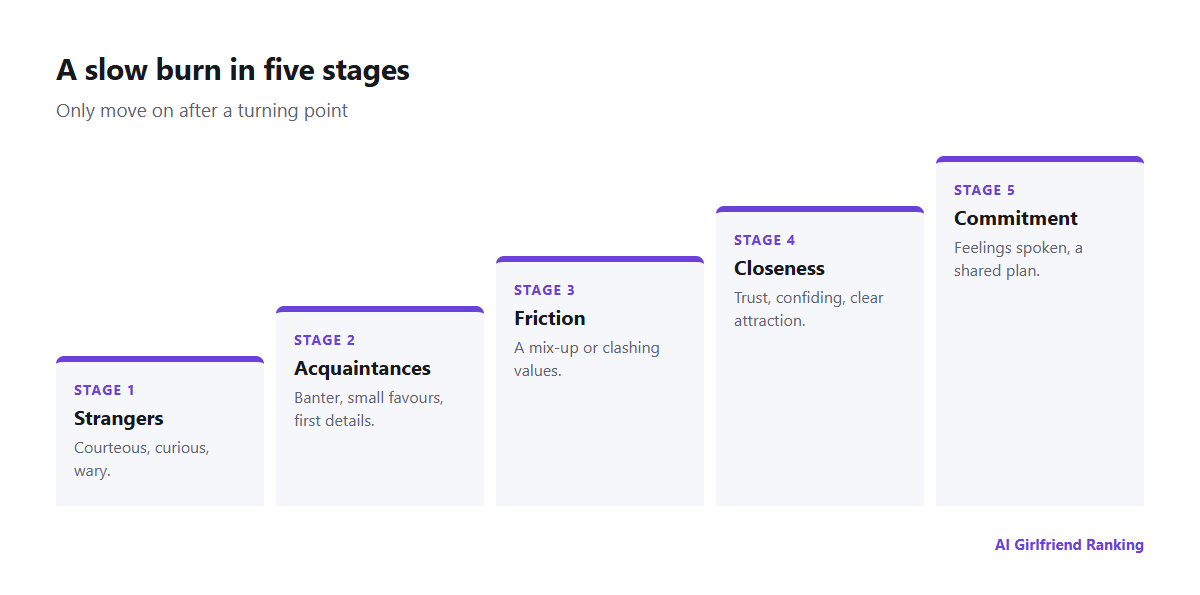
You only step up to the next stage once a turning point has actually happened.
| Stage | The mood | What tips it into the next stage |
|---|---|---|
| Strangers | Courteous, curious, a bit guarded | A shared problem, or bumping into each other again |
| Acquaintances | Banter, small favours, the first personal details | One of you needs a hand |
| Friction | A misunderstanding or clashing values | A frank talk that clears the air |
| Closeness | Trust, confiding, clear attraction | A choice that costs one of you something |
| Commitment | Feelings said out loud, a plan together | Whatever your story calls for next |
Before you begin, decide how many sessions each stage gets. About a week per stage is a sensible starting point.
Brief the character on tempo
Write the pacing into the character description, or drop an out-of-character note early on:
(OOC: This is a slow burn. We start as strangers. She's wary and won't fall for me fast. Only move things along when something significant happens in the story, never by default. No physical affection in the first two stages.)
There's more on this kind of instruction in roleplay prompts that work.
Pacing habits that keep the tension up
- One small step per session. Nudge the relationship forward a little each time, and don't blow through the whole arc in one sitting.
- Leave loose ends. Finish on a question rather than a neat answer.
- Give her a life of her own. A job, mates, troubles that have nothing to do with you. Scenes that aren't about the romance make the ones that are hit harder.
- Skip ahead in time. A line like [Three days later.] tells the model that time has passed, so it stops treating every session as the same night.
- Let things go wrong. A blow-up or a mix-up isn't the app failing. It's the messy middle that good stories need.
Keep a story log
Memory is where long arcs come unstuck. Jot a short log in a notes app on your phone or computer:
- Where you're up to: the stage, the last scene, the threads still open.
- Fixed facts: how you met, promises made, dates that matter.
- Her voice: a couple of lines of dialogue that sound just like her.
Paste a quick recap at the top of each session:
(OOC: Recap - we met at the night market three weeks ago. Last time we argued about the job offer and she left without saying goodbye. It's now two days later.)
If the app has a memory or notes feature, save the permanent facts there. The same document is handy when you switch apps, so it doubles as a backup.
Knowing when to finish
Arcs end, and that's what makes them arcs. Once the story has run its course, you can begin another with the same character, with a new setting and a fresh problem, or simply leave it be. Plenty of people find a story with a proper ending more satisfying than a romance that drifts along at the same level forever.