Social anxiety goes well beyond shyness. It is a constant worry about being judged or humiliated, and it can make a phone call, a team meeting or a mate's birthday feel like a test you are already failing. A companion app is the one conversation partner that cannot fail you back, which gives it some real value.
What makes it feel so easy
Take away the things that drive the anxiety and this is what is left:
- Nobody watching. No one sees you hesitate, blush or start over.
- Nothing carried forward. A fumbled message stays in that chat unless you drag it into the next one.
- No chance of being turned down. The character is built to stay, whatever you write.
- As many attempts as you like. Delete, reroll or rerun the scene until it suits you.
That ease is the whole appeal. It is also the hazard, since avoidance is what keeps anxiety alive: every time you slip out of something scary, the scary thing grows. A space with zero risk can become the most comfortable exit going.
Good ways to use it
Some numbers show how far practice can travel. A 2025 Common Sense Media survey of teens in the US found that 39% of those who used AI companions had brought a social skill they practised there into real life. The skills were mostly starting a conversation, giving advice and showing emotion. Most teens did not use companions this way at all, but for those who did, it transferred.
These uses tend to pay off:
- Nailing the first sentence. Lots of anxious people lock up in the opening moments. Try out a handful of openers until one feels like you, and the toughest stretch is behind you.
- Running through one particular conversation you dread. Asking to swap a shift, taking a faulty item back, telling a friend they upset you. Get the character to play the other side with some resistance.
- Practising the stumble. Blurt something clumsy on purpose and carry on. Anxiety says a slip ends everything, and repetition proves otherwise.
- Finding words for feelings. Typing "that made me feel small" is easier with a listener who never tires of you, and easier again when you repeat it to a person.
The exercises for all four are in practising conversation with an AI companion.
Ways it works against you
- It becomes the substitute. Rehearsing a phone call ten times without ever dialling is avoidance with extra steps.
- Being agreed with sets the bar. Companions go along with almost anything you say. Real people push back, drift off and misunderstand. If her warmth becomes your picture of a good chat, human ones start to feel like flops.
- It crowds out people. A 2025 study by OpenAI and MIT linked heavier daily chatbot use with less time spent socialising. Nobody has shown which causes which, but it is a pattern to keep an eye on. See when an AI companion starts taking more than it gives.
From the app back to people
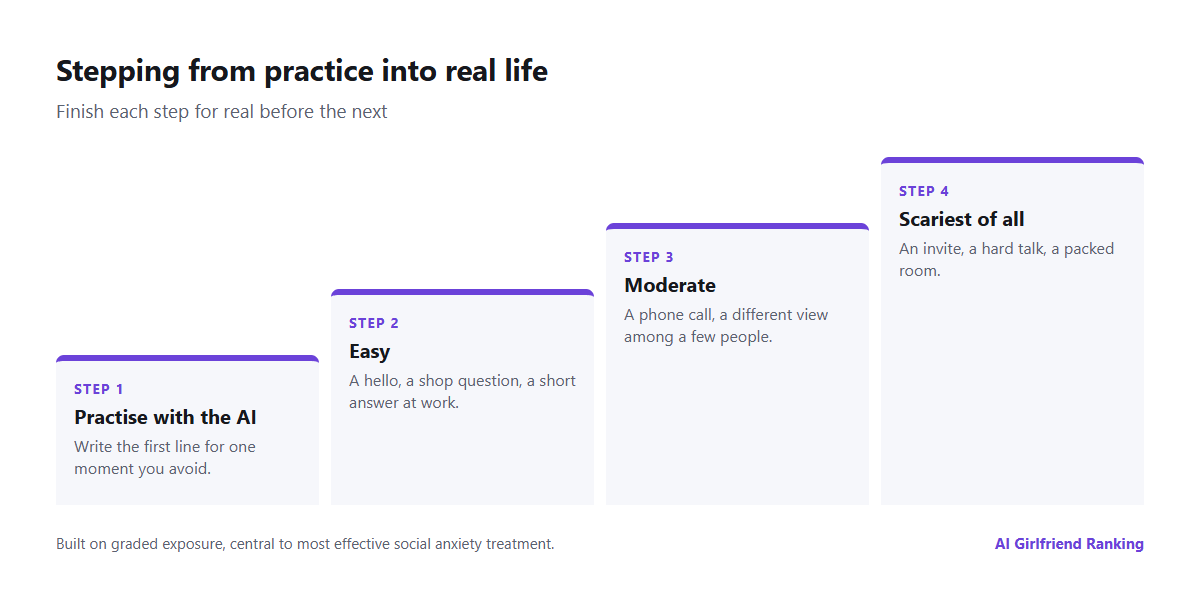
Finish each step in real life before starting the next. The app just gets you ready.
This is modelled on graded exposure, the backbone of most successful anxiety treatment. You meet what you fear in small doses, least scary first, and stay in it until the fear settles.
| Stage | Practise with the AI | Then do the real thing |
|---|---|---|
| 1 | Say hello, add one follow-up question | Greet a workmate and ask how they spent the weekend |
| 2 | Order food, ask for help in a shop | Ask staff in a shop something you actually want to know |
| 3 | A brief phone call read from a script | Phone to book an appointment instead of clicking online |
| 4 | Disagree without being rude | Offer a different opinion among a few people |
| 5 | Invite someone to do something | Ask an acquaintance whether they fancy a coffee |
Two habits help. Keep each rehearsal short, three or four goes and not the whole night. And pick the date for the real attempt before you start practising, so the effort points somewhere.
Turn down the niceness
Left alone, a companion aims to make you feel good. Rehearsal works better with some friction, within reason. Tell her:
(OOC: In this scene you're my landlord. You're rushed and a bit short with me. Don't give in on the first ask. At the end, name one thing I did well and one thing I should change.)
An out-of-character instruction like that, a trick explained in roleplay prompts that work, swaps a cosy chat for a workout.
When it is time to see someone
If anxiety is getting between you and your job, your studies, your friends or even leaving home, see your GP. In Australia a GP can draw up a mental health treatment plan, which opens up Medicare rebates for appointments with a psychologist and other eligible providers. CBT for social anxiety is well studied and often comes as a short course. To talk to someone straight away, Beyond Blue's support service (1300 22 4636) runs around the clock. If you are in crisis, ring Lifeline on 13 11 14, and call 000 if it is an emergency. Anyone aged 12 to 25 can also reach headspace on 1800 650 890. Telling a professional you practise with a companion app gives them useful context, and there is no reason to hide it.
Treated as a rehearsal space with a door to the street, a companion can shrink the first steps. Treated as a room you never leave, it moves the street further off.