Three questions are worth asking about any AI companion number: who did the counting, what exactly got counted, and in which country? App-store data can't see web-only services. A survey answer depends heavily on the wording. And a market "forecast" is often a sales pitch in disguise.
The main figures at a glance
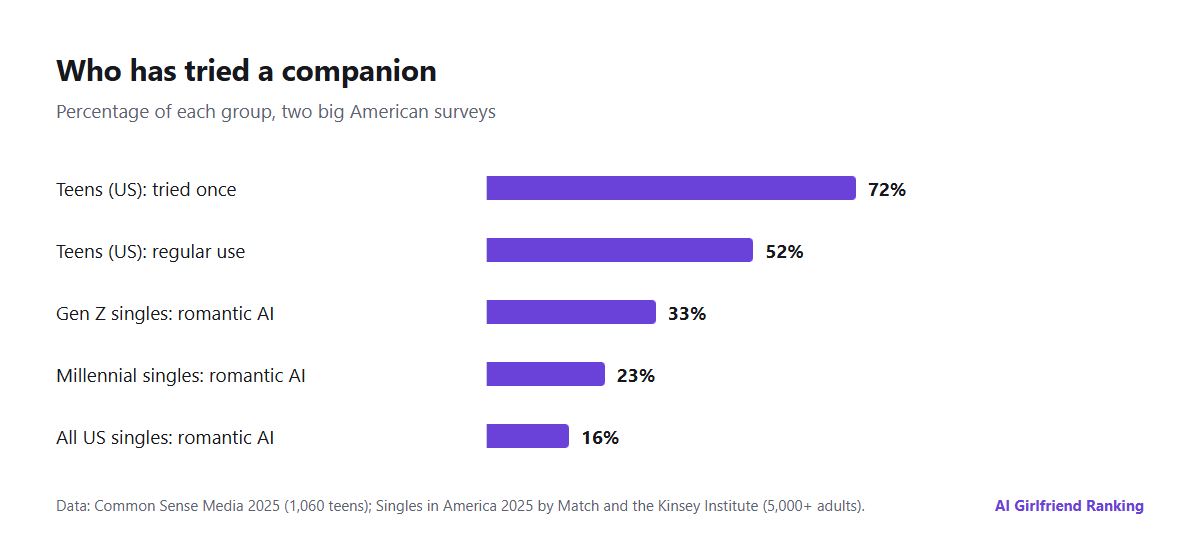
The share of each group that has used a companion, from the two largest surveys, both American.
| Measure | Figure | Origin | Scope and limits |
|---|---|---|---|
| Companion app downloads to date | 220 million | Appfigures report (Jul 2025) | Counts iPhone and Android stores only |
| App-store spending, Jan to Jun 2025 | US$82 million | Appfigures | Web purchases not included |
| Expected 2025 app-store spending | More than US$120 million | Appfigures | An estimate, for mobile only |
| Companion apps that make money | 337 | Appfigures (mid-2025) | 128 launched during 2025 |
| Slice of revenue taken by the top tenth of apps | 89% | Appfigures | The market is heavily lopsided |
| American teens who've tried a companion | 72% | Common Sense Media survey, 2025 | 1,060 teens, aged 13 to 17 |
| American teens who use one often | 52% | Common Sense Media survey, 2025 | Several times a month at least |
| American singles who've used AI romantically | 16% | Match and Kinsey Institute study, 2025 | Over 5,000 adults; caveat below |
| Same measure, Gen Z singles | 33% | Match and Kinsey Institute study, 2025 | |
| Singles who'd call an AI partner cheating | 40% | Match and Kinsey Institute study, 2025 |
Caveat on the Match result: coverage of the study suggests the phrase "interacting with AI as a romantic companion" could include anyone who got AI help with a dating profile or message, not just people with an AI partner. Treat 16% as a ceiling.
Why people turn to them
Common Sense Media's teen survey reported that:
- Around a third of teens used companions for connection, whether that meant rehearsing conversations, getting emotional support, roleplay or romance.
- 39% of teens who used them said they'd carried skills practised with AI into real life.
- 31% said chats with AI were at least as satisfying as chats with friends, though 80% still gave more of their time to real friends.
Among singles with an AI partner in the Match adult study, 45% said it left them feeling better understood, and 44% said the emotional support beat what they got from people.
Small, top-heavy and growing fast
Set against consumer AI apps as a whole, which pulled in more than US$1.4 billion in 2024 on Appfigures' numbers, companions are a small corner. Growth is strong, though. Downloads for the first half of 2025 rose 88% on a year earlier, and earnings per download more than doubled. A handful of apps take nearly all the money and most of the hundreds on offer barely earn anything.
The store data misses two big groups:
- Website subscriptions. Lots of adult-oriented apps sell mostly or entirely through their own sites, partly because of app store content rules. That revenue never reaches store figures. See browser or app store for the trade-offs.
- General chatbots pressed into companion duty. Some people treat ChatGPT, Claude or Grok as a friend. Joint OpenAI and MIT research found emotional use of ChatGPT was rare overall, but concentrated among a small set of heavy users.
Figures that deserve a raised eyebrow
- "The AI companion industry will be worth $X billion by 2030." Forecasts span orders of magnitude and usually come from report sellers.
- User totals quoted by the apps themselves. Registered accounts say nothing about who's active.
- Engagement claims about one character, such as minutes per day, which often trace back to unsourced blog posts.
- Percentages missing a denominator. 40% of which users, and how were they asked?
Where to follow updates
Appfigures and other app-analytics firms release regular category reports. Common Sense Media and the Singles in America study from Match and Kinsey run their surveys again from time to time. For research on wellbeing, see whether AI companions help mental health, and for how the money is made, see how AI companion apps make money.