Nothing in here needs a computer science degree. Every entry says what a word means when you're actually using an app, plus where it tends to show up. Follow the links for the fuller explanations.
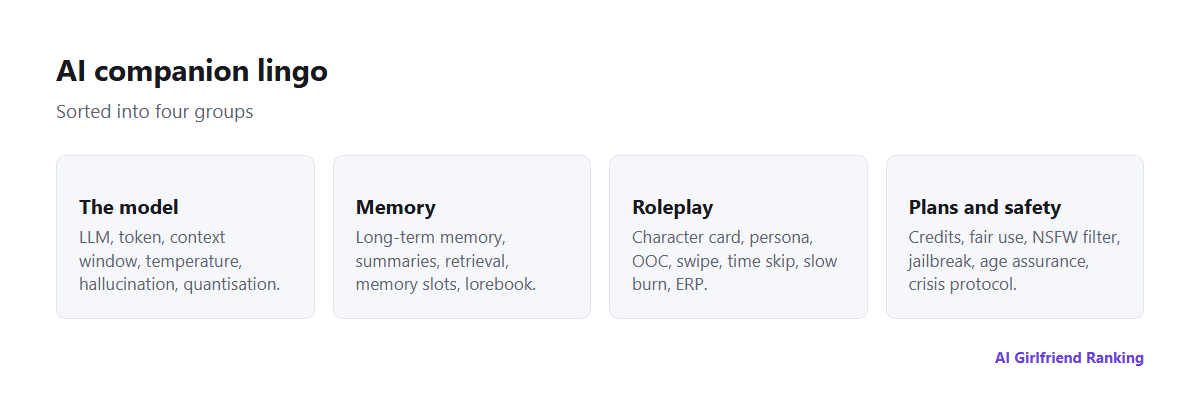
Four groups, four sections below.
How the model works
LLM (large language model). Software trained on huge amounts of writing so it can guess the most fitting next words. Each companion app sits on top of one, either its own or a rented one. See what is an AI girlfriend app.
Token. A small slice of text, around three-quarters of a word in English. Limits and bills are frequently counted this way.
Context window. The most tokens the model can look at in a single go. Once a chat outgrows it, the oldest details drop out of sight.
Temperature. A setting that controls how adventurous the phrasing gets. Higher gives livelier, less predictable replies, lower gives cautious, repetitive ones. See how an AI companion writes its reply.
Sampling. The way the model chooses one word from several options. Temperature is one of a handful of sampling settings.
Hallucination / confabulation. A confident statement that's simply wrong, such as remembering something that never happened. See why AI companions invent memories.
Fine-tune. A model that's had extra training toward a certain style, roleplay for example. Hobbyists running models at home often hunt for these.
Quantisation. Shrinking a model so it runs on weaker hardware, trading away a bit of quality. Worth knowing if you run a companion locally.
Multimodal. Capable of handling images, voice or video as well as text.
Memory
Long-term memory. Details and recaps the app stores, then returns to the model in later chats. See how AI companion memory works.
Summary memory. Condensed notes on earlier chats, written by the model itself. They save space but shed detail.
Retrieval. Searching the stored memories for anything that suits your newest message and adding it to what the model gets to read.
Memory slots / journal. A visible list of what the app has filed away about you. Some let you edit it.
Lorebook / world info. Entries that get dropped into the context whenever a matching keyword appears. Common in SillyTavern and other advanced tools.
Roleplay
Character card. A file bundling a character's description, temperament, sample lines and greeting. Frequently a PNG with the data embedded inside.
Persona. The profile you write for yourself, meaning who you are in the story.
Greeting / first message. The character's opener. It sets the style and length the rest of the chat copies.
Example dialogue. Sample lines in the character's own voice. It's the strongest guard against personality drift.
OOC (out of character). A bracketed aside directed at the AI as a writer. See roleplay prompts that work.
Regenerate / swipe. Requesting another attempt at the last reply.
Time skip. A line such as [Two days later.] that jumps the story forward.
Slow burn. A romance that develops gradually. See slow burn with an AI companion.
Group chat. A single conversation with multiple characters, each keeping their own personality.
ERP. Erotic roleplay.
Godmodding. The AI taking over your character and writing their actions or lines. Mostly unwelcome.
Money, safety and rules
Free tier. Whatever you can use without paying. See free AI girlfriend apps.
Credits / tokens / gems. Virtual currency spent on images, voice and extras, charged on top of the subscription. See monthly, annual or credits.
Fair use cap. A hidden ceiling behind an "unlimited" claim, most often on images or voice.
NSFW filter. Automatic blocking of sexual or graphic material. See content filters.
Uncensored. Sales talk for a loose filter. Somewhere, there's always a line.
Jailbreak. A prompt engineered to dodge a model's guardrails. It normally breaks the terms of service, and it's a frequent reason for flagged accounts.
Age verification / age assurance. Evidence that you're an adult. See age verification on AI companion apps.
Crisis protocol. The scripted reaction when a user mentions suicide: the character steps out of the role and shows a helpline. In Australia, eSafety's codes expect companion chatbots to provide this kind of crisis information.
Data export / access request. Asking a company for a copy of the information it holds on you. See how to request your data.
Web app / PWA. An app that lives in your browser and can often be saved to your home screen. See browser or app store.
Model update. The company changing what's under the hood, which can make a character sound different overnight.
Affiliate link. A link that earns the referring site a payment if you sign up. We use them too, flag them on every page and explain our approach in how we test.